






































Key Takeaways
- The most energy-efficient air conditioner for you is the one matched to your home's build and climate, above any single rating number.
- SEER2 and EER2 cover central and ductless systems; CEER covers window and portable units. Never compare them across types.
- Mini-splits lead on efficiency, with central systems next, then wall, window, and portable units.
- A variable-speed inverter compressor is the feature that sets an energy-efficient AC unit apart from a wasteful one.
- Correct sizing beats a higher rating. Oversized units waste power and leave the air damp.
- Smart control cuts the hours your system runs, saving money on top of any rating.
- The federal 25C credit ended in 2025. State HEAR and utility rebates are where savings are now.
Cooling is one of the biggest costs on a home electricity bill. Air conditioning makes up about 19% of residential electricity use across the United States, and close to 12% of what the average household spends on home energy overall.
Two homes can install air conditioners that cost the same and still face very different summer bills. What decides the difference is the type of system, its efficiency rating, how well it fits the space, and how you run it day to day. Get those right, and the most energy-efficient air conditioner for your situation stays affordable.
An air conditioner with low power consumption is within reach for a rented studio or a full house. Finding yours starts with reading the ratings correctly.
All You Need to Know About Energy-Efficient Air Conditioners
What SEER2, EER, and CEER Measure

Three ratings describe how efficiently a cooling system runs, and each applies to a different kind of equipment. Reading them correctly keeps you from comparing numbers that were never built to line up.
|
Rating |
What it measures |
Used for |
Good value |
|
SEER2 |
Average efficiency across a full cooling season |
Central systems and mini-splits |
16+ (22+ for top tier) |
|
EER2 |
Efficiency at peak heat, 95°F outside |
Central systems and mini-splits |
12+ |
|
CEER |
Efficiency including standby power draw |
Window and portable units |
12+ |
SEER2
SEER2 is the seasonal figure on central and ductless systems. It took over from the older SEER standard in January 2023, when testing switched to a tougher method that matches installed conditions more closely, which is why SEER2 figures read about 4 to 5% lower than the SEER numbers on older units. Our glossary explains what SEER rating means in full.
EER2
EER2 measures performance on the hottest days, at 95°F outside, when the compressor works its hardest. In a long, hot summer where the system runs near its limit for weeks, EER2 tracks your real bill more closely than the seasonal average.
CEER
CEER applies to window and portable units. It counts the power they draw while idle, which adds up because a plug-in unit spends far more time on standby than a central system does.
One comparison causes the most confusion. A window unit's CEER and a central system's SEER2 come from different tests, so putting them side by side tells you nothing. Once a central system loses cooling through its ducts, a window unit near 12 CEER and a central system near 16 SEER2 reach the room with similar real efficiency.
Which Air Conditioner Types Are Most Efficient
One rule outranks the rest. Among units of the same type, a higher SEER2 or EER always wins. The type you pick decides the range you can reach. The most efficient air conditioner for your home is the one matched to how the home is built. A premium window unit will never match the efficiency of a mid-range mini-split, however high its rating climbs.
Ranked from most efficient to least, the main types of air conditioners compare like this:
|
Type |
Rating range |
Best for |
|
Ductless mini-split |
15–35 SEER2 |
Room-by-room cooling, homes without ducts |
|
Central ducted |
14.3–28 SEER2 |
Whole-home cooling with existing ducts |
|
Through-the-wall |
EER 9–11 |
Single rooms, permanent install |
|
Window |
CEER 9–15 |
Single rooms, renters |
|
Portable |
EER 8–10 |
Temporary cooling, tight spots |
1. Ductless Mini-Splits (Most Efficient)
Ductless mini-splits top every efficiency ranking, with premium models reaching 33 to 35 SEER2. They skip ducts entirely, so no cooled air escapes before it reaches you, and they run variable-speed compressors that adjust output to the room's needs. Set up as a mini-split AC for one zone or several, they give the lowest running cost per unit of cooling you can buy.
The trade-off is a higher install price.
2. Central Ducted Systems
Central systems cool a whole house from a single unit, rated from the 14.3 SEER2 federal minimum up to about 28 SEER2 at the top. Ductwork is the weak point. A typical duct run loses 20 to 30% of its cooling through leaks and gaps before the air arrives, which drags real efficiency below the label. Central air fits homes that already have sound ducts in place.
3. Through-the-Wall Units
Through-the-wall units mount through an exterior wall and stay fixed. They carry EER and CEER ratings, usually around EER 9 to 11. They cool a single room well but can't reach the efficiency of ducted or ductless systems, since the parts that make those efficient won't fit inside a wall sleeve.
4. Window Units
Window units are the practical choice for renters and single rooms. The best inverter models now hit about 15 CEER, well above the 9 to 10 CEER of standard units. They cost little and install in minutes, though they seal poorly against outside air and take up a window.
5. Portable Units
Portable units are at the bottom for efficiency and draw more power than a window unit of the same size. Single-hose models pull warm air back into the room while they run, which forces the compressor to work longer. They make sense only where a window or wall unit can't go.
For specific models to shortlist, see our guide to the top energy-efficient air conditioner brands for 2026.
The Features That Move Your Bill

Ratings give you the headline number. Three features decide whether an energy-efficient AC unit holds that number in daily use. Look for them on any system type.
A Variable-Speed Inverter Compressor
A single-speed compressor runs at full power, shuts off, then restarts, again and again. Every restart spikes the power draw and adds wear. An inverter compressor adjusts its speed to the exact cooling a room needs and holds a steady low output most of the time. This one feature accounts for most of the distance between a cheap unit and an efficient one.
A Strong EER2 for Hot Climates
SEER2 averages performance over a full season, including mild days when any unit looks good. EER2 shows what happens at 95°F, when cooling demand peaks and efficiency drops. If your summers are long and hot, a high EER2 protects you on the days that push your bill the highest.
A Variable-Speed Blower
The compressor gets most of the attention, and the blower that moves air across the coil matters nearly as much. A variable-speed blower, listed on specs as an ECM motor, adjusts airflow to conditions and draws far less power than a fixed-speed fan stuck on one setting. Across hundreds of hours a summer, that shows up on every bill.
How to Calculate Real Cost and Payback
A higher rating only pays off when the savings beat the extra cost. You can run the math yourself before buying.
Estimate Annual Running Cost
Multiply the unit's wattage by hours of use per day, divide by 1,000 for daily kWh, then multiply by your electricity rate and your number of cooling days.
Worked with a 3,000-watt central unit running 8 hours a day at about 18 cents per kWh, across a 90-day season:
- 3,000 watts × 8 hours = 24,000 watt-hours a day
- 24,000 ÷ 1,000 = 24 kWh a day
- 24 kWh × $0.18 = $4.32 a day
- $4.32 × 90 days = about $390 for the season
Compare Across Rating Levels
The same cooling job costs less as the rating climbs, which is how you spot the most efficient air conditioner for the money. Annual cooling cost for a central system doing identical work, at an average rate:
|
SEER2 |
Estimated annual cooling cost |
|
14.3 (minimum) |
~$420 |
|
18 |
~$335 |
|
22 |
~$275 |
|
26 |
~$250 |
Work Out the Payback
Subtract the efficient unit's yearly cost from what you pay now, then divide the price difference by that saving. A unit that saves $150 a year and costs $900 more pays for itself in six years. With a service life of 15 to 20 years, the savings run well past the payback point.
For your own figures, our guide on how much electricity your AC actually uses per month breaks the steps down further.
Size the Unit to the Space First
Most oversized air conditioners get that way on purpose. A contractor who fits a unit slightly too small gets a callback on the first 100-degree day, so the safe move for them is to round the tonnage up. You pay for that padding every month afterward.
An oversized system reaches your thermostat's target in a few minutes and shuts off, which looks efficient until you feel the air. An air conditioner only removes moisture while it runs, and a short burst never lasts long enough to dry the room. You get a space that's cold and clammy, plus a compressor that cycles on and off every few minutes, spiking power on each restart and wearing out early.
Right-sizing comes from a Manual J load calculation. It fits the equipment to your home using square footage, insulation, window size and placement, air sealing, and local climate. On a replacement, don't let anyone copy the old unit's tonnage, since the original was often oversized to begin with. Ask for the Manual J in writing before you sign. We'd walk away from any crew that won't run one.
How Smart Control Adds Efficiency on Top of the Rating

Even an energy-efficient AC unit wastes power cooling an empty house or a room that's already cold, and no rating covers those hours.
A smart controller trims them with a few adjustments:
- Scheduling eases cooling off while you sleep or work, and brings it back before you return.
- Geofencing reads your phone's location to switch the unit off when the last person leaves and on as someone heads home.
- Climate React holds a target temperature or humidity by adjusting the unit on its own as conditions change.
The hardware stays the same. The hours it runs go down, and runtime is what you pay for. Savings track your habits, so a household that already cools carefully gains less than one that leaves the unit on all day.
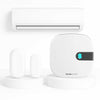
Replacing the system isn't required. The Sensibo Air Pro works with the air conditioner you already own, adding scheduling, geofencing, and climate control to any unit that takes a remote. For most homes, that does more for real consumption than a few extra SEER2 points.
Rebates and Incentives in 2026
Federal support for efficient cooling narrowed at the start of 2026, so check what's left before counting on any of it.
The Energy Efficient Home Improvement Credit (Section 25C), the federal tax credit worth up to $600 toward a central AC and $2,000 toward a heat pump, expired on December 31, 2025. Equipment installed in 2026 doesn't qualify, regardless of its rating. Many older guides, and some newer ones, still describe this credit as active, so treat any 2026 claim about it carefully.
What still helps:
|
Program |
Status in 2026 |
What you get |
|
Federal 25C tax credit |
Expired Dec 31, 2025 |
Nothing for 2026 installs |
|
HEAR rebates (state-run) |
Live where states have launched |
Up to $8,000 toward a heat pump, income-qualified |
|
State and utility rebates |
Active in many states |
Varies, often $150 to $500 per qualifying unit |
Your state energy office and your utility's website are the two places to confirm what's current. Amounts and rules shift by region and by year, so verify the terms before you buy.
FAQ
What is the difference between SEER and SEER2?
SEER2 replaced SEER in January 2023. It uses a stricter test that raises the static pressure on the system to match real installations more closely. Both describe seasonal cooling efficiency, but SEER2 numbers run about 4 to 5% lower than the old SEER figure for the same equipment.
Does a higher SEER2 rating always mean a better AC?
Only when you compare units of the same type. A higher SEER2 central system beats a lower one. A high SEER2 means nothing against a window unit's CEER, and it won't fix a system that's oversized or poorly installed. Match the type and size first, then compare ratings.
What is the most energy-efficient air conditioner for an apartment?
For most apartments, a ductless mini-split is the most energy-efficient air conditioner available, often reaching 20 or more SEER2. Renters who can't install one should look at an inverter window unit around 15 CEER. Both cool a single space far more cheaply than a portable unit of the same capacity.
How much does it cost to make an existing AC smarter without replacing it?
A smart AC controller runs roughly $100 to $200, with no installation cost. It clips onto any unit that uses a remote and adds scheduling, geofencing, and app control. For a fraction of the price of a new system, it cuts the runtime waste that a high rating alone can't touch.
Is a window AC or portable AC better for a small room?
A window unit wins on efficiency nearly every time. It draws 20 to 30% less power than a portable unit of the same size, cools more steadily, and costs less to run. Pick a portable only when a window can't hold a unit, since single-hose models pull warm air back into the room.
How long does it take to recoup the cost of a more efficient AC?
Most efficiency upgrades pay back in four to eight years, depending on the price gap, your local rate, and how hard you run the system. Divide the extra cost by your yearly savings to get the number. Since a unit lasts 15 to 20 years, the savings usually outlast the payback by a wide margin.