







































You'll learn:
- Which fan position moves cold air between rooms, and why the one already sitting in your doorway is probably facing the wrong way.
- The door that has to stay open, the ones that should stay shut, and the type of house where that rule reverses.
- What separates a single-head mini split from the system that covers a whole floor, and the price gap between them.
- How long a closed room holds what it was given, and what decides the number.
- The heat a far room accumulates hours before any cold air reaches it.
Keeping multiple rooms cool with a single air conditioning unit in the summer months is a challenging task. On the other hand, if you know how to cool multiple rooms with one AC effectively, then you can save energy costs around your house and condition or provide better living in many different ways.
The equipment is not what stands between you and an evenly cooled house. What decides it is how air travels from one room to the next, how much heat is waiting for it when it arrives, and when the unit runs. One AC will hold two rooms when all work in its favor.
All You Need to Know About Cooling Multiple Rooms with One AC
1. Place Your Fans at Floor Level and Aim Them Through the Doorway

Set the fan on the floor and point it through the doorway rather than into the room. Cold air collects at floor level, so a fan working down there moves the coldest air in the house, while one mounted or aimed high circulates air that was already warm.
Three placements do the work, and they suit different layouts:
- On the floor in the doorway of the cooled room, facing the warm one. Picks up the coldest layer in the house and moves it toward the space that needs it.
- In the far corner of the warm room, facing back toward the doorway. Pushes warm air out and lets cold air move in behind it, which tends to outperform the first option when the doorway is narrow.
- Ceiling fan in the warm room, running counterclockwise. Handles comfort once the air has arrived and contributes nothing to getting it there.
Fans don't lower air temperature, they move air across skin, which speeds evaporation and makes a room feel cooler than the thermometer says. Ceiling fans cool people rather than rooms, so one left running in an empty room spends electricity on nothing. Where somebody is there to feel it, the thermostat can go up as much as 4°F (2°C) before comfort changes.
How hot and cold air moves through your home covers the underlying mechanism.
One widely repeated tip works against you here. A box fan in an open window while the AC runs pulls outdoor air into the house, and the unit then spends the afternoon removing heat and humidity the fan invited in.
2. Manage Your Doors So the Air Can Move Both Ways
Doors to Rooms You Want Cooled
These stay fully open rather than cracked. A door resting at 45 degrees cuts the opening roughly in half and slows both directions at the same time, and those two flows are already competing for one gap.
Rooms You Are Leaving Out
These stay closed. Every open door adds volume the unit has to hold, including bathrooms, laundry rooms, the spare bedroom nobody sleeps in, an attached garage, and a stairwell down to an unused basement. Where cold air drains out under one of those doors, a draft stopper settles it for a few dollars.
If You Have a Central System with One Return
Ducted houses reverse part of this. Closing a bedroom door pressurizes the room, which limits how much supply air it will accept and pushes conditioned air out through the wall cavities instead.
ENERGY STAR holds that pressure difference to within 3 Pascals in new construction, using door undercuts, transfer grilles, or jump ducts to give the air a route back to the return. Older houses rarely meet that figure, and a half-inch undercut with carpet packed underneath meets it less often still.
3. Add a Second Indoor Head If the Doorway Can't Deliver

Running one split AC for two rooms gives the second room whatever crosses the doorway and nothing more. A single-head unit pairs one outdoor condenser with one indoor head. Holding a second room at its own temperature takes a multi-zone system, which is different hardware rather than a larger version of the same thing.
|
|
Single-head mini split |
Multi-zone mini split |
|
Indoor heads |
One |
Two to eight |
|
How the second room gets cooled |
Through the doorway |
Its own head on the wall |
|
Independent temperature per room |
No |
Yes |
|
Refrigerant lines |
One run |
One run per head |
|
Adding a room later |
Not possible |
New line set and head, licensed install |
Cost is what separates the two in practice. Multi-zone is the only method here that removes the problem instead of working around it, and it costs more than the other four combined. Refrigerant work requires EPA Section 608 certification, and most manufacturers decline warranty claims on lines opened by an uncertified installer.
Our article on what is a mini split air conditioner covers how the equipment works if you're weighing the two.
4. Schedule the Unit to Pre-Cool the Far Room
Run the unit with the far room's door open through the late afternoon, while nobody is using that room, then close the door at bedtime. The room starts the evening several degrees below where it otherwise would, and a closed door holds most of that through the night.
A two-room schedule has three parts:
- A pre-cool block. The unit runs at a lower setpoint with the far room's door open, timed to finish before anyone needs the room.
- A drift alert. A sensor in the far room reports when it has climbed past your threshold, which is the signal to open the door and run the unit again.
- An off condition. Geofencing or occupancy detection, so the unit stops when the house empties rather than holding a setpoint for nobody.
How much the room holds depends on the room. A shaded, well-sealed bedroom stays comfortable for hours, while a west-facing upstairs room in August gives it back inside of one.
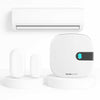
The sequence also only pays off when it happens every day at the right hour, and that's the part people abandon by the second week. Cooling multiple rooms with one AC stops being a daily decision at that point, because a smart AC controller for automated scheduling runs the pre-cool on a schedule and holds it there through the season.
5. Cut the Heat Load Before the Cold Air Arrives
Close the far room's window coverings by mid-morning, seal the gaps around its windows and doors, and move the heat-producing equipment somewhere else. Each one lowers how much cooling that room needs before any air reaches it, and together they cost less than anything else here.
What to clear out:
- Direct sun on the glass. The largest single load in most rooms and the one people leave until the afternoon.
- Gaps around window frames and exterior doors. Weatherstripping and caulk, an afternoon of work that holds for years.
- Desktop computers and game consoles. A machine under load gives off several hundred watts of heat continuously, for as long as it stays on.
- Incandescent and halogen bulbs. Most of the power they draw leaves as heat rather than light.
- A second fridge or a chest freezer. Standard equipment in spare rooms and garages, running around the clock.
- Ovens, dryers, and dishwashers. Worth shifting to the evening where the far room shares a wall with them.
The strongest move through cooling season is closing window coverings during the day and opening them at night once it's cooler outside than in, with east-, south-, and west-facing glass taking priority.
Exterior shades outperform interior ones because they stop the sun before it passes through the glass, and DOE field studies put whole-home summer cooling savings from well-operated shades at 15% to 25%. Drawing anything at four in the afternoon is too late, since the walls, floor, and furniture have already absorbed the sun and go on releasing it through the evening.
How Far One AC Can Reach

Getting one AC to hold two rooms works across a single doorway on the same floor. Two doorways with a hallway turn between them does not, a room above the unit does not, and neither does any layout where the unit lacks the capacity for both rooms added together.
Doorways are more important than square footage. Each opening cuts the flow again, and the air loses its temperature difference along the route. Vertical distance is harder than horizontal for the same reason cold air collects at floor level, so a room above the unit stays warm no matter how long the unit runs.
Capacity sets the other limit, and it's where most of these attempts fail. ENERGY STAR sizes room air conditioners by floor space, beginning at 5,000 BTU for 100 to 150 square feet and stepping up from there. A 280 square foot living room takes roughly 7,000 BTU on its own, and adding a 150 square foot bedroom brings the combined 430 square feet into the 10,000 BTU bracket.
A unit sized for the living room by itself has no headroom for a second room, and fan placement cannot create capacity that was never installed. In our own support cases, undersized equipment explains more of these complaints than airflow does, though that's what we see rather than a published finding.
Where the unit runs continuously and still cannot hold its own room, the equipment has failed you before the airflow ever did. A clogged filter, a dirty evaporator coil, and a condenser packed with leaf litter all strip capacity from a unit that was sized correctly the day it went in.
Clear those, and you make your air conditioner work more efficiently without spending anything, which is the cheaper move before handing it a second room.
FAQ
How Many BTUs Do You Need for One Split AC for Two Rooms?
Add both rooms together and size for the total rather than for the larger one. A 200 square foot room plus a 150 square foot room comes to 350, which lands in the 9,000 BTU bracket instead of the 6,000 BTU unit either would take by itself.
Can 1 AC for 2 Rooms Work if the Rooms Are on Different Floors?
Not upward. Cold air settles, so a ground-floor unit will never reach a room above it, though a unit upstairs with the door open will drop some of its cold air to the floor below.
Is It Cheaper to Run 1 AC for 2 Rooms or Two Smaller Units?
Running 1 AC for 2 rooms usually costs less, provided the unit has capacity for both, since one unit running steadily draws less power than two undersized ones short cycling all afternoon. Two units win only where the rooms are occupied at completely different hours, and one can stay switched off.
Will Running One Unit for Two Rooms Wear It Out Faster?
Long runtime does no harm on its own, and compressors cope with continuous operation better than with frequent restarts. The unit to worry about is one running without pause and never reaching setpoint, which gets no rest cycle and can ice its evaporator coil.
How Long Should the Second Room Take to Cool Down?
The far room settles a few degrees above the room holding the unit and then holds that gap instead of closing it, which is the expected result and not a fault. A small gap points at shading and heat sources, while a large one means the air isn't reaching the room at all.