





































The Short Version
- Kids breathe more air for their size than adults, so classroom pollutants hit them harder than they hit staff.
- Six pollutants cause most of the trouble, and CO2 doubles as your fastest gauge of how well ventilation is keeping up.
- Schools pack roughly four times the people per square foot of an office, often on HVAC that 41% of districts already need to replace.
- Pandemic relief that paid for a wave of HVAC upgrades has run out, so low-capital fixes matter more than full replacements right now.
- Monitoring earns its keep only when it runs continuously, sits in the breathing zone, ties to clear thresholds, and triggers a written response.
Children pull in more air for every pound of body weight than adults do, so a stuffy classroom reaches them at a higher dose than it reaches the grown-ups in the room. That is part of why managing K-12 facilities falls to the districts that run them, which puts indoor air quality in schools on a facilities or administration desk, not on some distant environmental agenda.
It shows up in three places you already answer for. Bad air drives asthma flare-ups and sick days, drags down the test scores that fresh air and temperature measurably lift, and increasingly puts you crosswise with state rules that now mandate classroom air checks. The same research linking better ventilation and cooler rooms to higher scores is the clearest read on how classroom temperature and air quality affect student learning.
All You Need to Know About Indoor Air Quality in Schools
What's in the Air Your Students Breathe
Six contaminants account for most classroom air problems. Each has a point where health or focus starts to slip, and most stay invisible until you measure them.
|
Pollutant |
Where it comes from in schools |
Level to watch |
What happens past it |
|
Carbon dioxide (CO2) |
Exhaled breath in packed rooms |
~1,000 to 1,100 ppm, roughly 700 ppm over outdoor air |
A sign the room is under-ventilated, not a poison at these levels. Comes with drowsiness and harder concentration, and flags the stale air that lets everything else build up. |
|
Fine particles (PM2.5) |
Traffic and wildfire smoke pulled indoors, dust, weak filters |
24-hour average over 15 µg/m³ |
Small enough to cross from lungs into blood. Triggers asthma, cuts lung function, tracks with sick days. |
|
Nitrogen dioxide (NO2) |
Nearby traffic, gas heating, buses idling at drop-off |
24-hour average over 25 µg/m³ |
Inflames airways and is linked to new asthma cases in children. |
|
VOCs and formaldehyde |
New furniture, flooring, paint, cleaners, lab chemicals |
Formaldehyde near 0.1 mg/m³ over 30 minutes (WHO indoor guideline) |
Eye, nose, and throat irritation, headaches. Formaldehyde is a carcinogen with repeated exposure. |
|
Radon |
Soil gas seeping through slabs, worst in ground-floor rooms |
4 pCi/L |
Second-leading cause of lung cancer. About one in five U.S. schools has a room above this level. |
|
Carbon monoxide (CO) |
Faulty boilers, gas appliances, attached garages |
24-hour average over 4 mg/m³ |
Headaches, dizziness, dulled thinking, and a medical emergency at high doses. |
Carbon dioxide is the one people misread. It does not poison anyone at classroom levels. It works as a gauge. When 25 kids breathe into a sealed room, CO2 climbs alongside everything harder to detect, so a reading well past 1,000 ppm is your fastest sign that fresh air has fallen behind.

Why Schools Get Hit Harder Than Most Buildings
Your buildings stack the deck against clean air in ways a typical office never has to.
Density comes first. A school holds about four times as many people per square foot as an office, so exhaled CO2 and aerosols climb fast in rooms that were rarely sized for that crowd.
The equipment is often the weak link. An estimated 41% of U.S. districts need to replace HVAC in at least half their schools, roughly 36,000 schools running units that leak, short-cycle, or never hit their rated airflow. A system can cool a room and still pull in almost no outdoor air.
Weather removes the cheap fallback. Opening a window works until it hits 98°F (37°C) outside or drops below freezing, at which point it wrecks comfort and energy bills and often breaks policy. Rooms that lean on operable windows end up sealed exactly when they are most crowded.
Money keeps all of it in place. The dollars that funded a rush of classroom HVAC work had to be committed by September 2024, and most are spent. Districts are back on tight capital budgets, which is why the cheapest workable fix usually beats the ideal one.

Three Ways to Clean Up a Classroom's Air
You have three levers, and monitoring tells you which one to pull.
- Source control. Swap high-VOC cleaners and materials, vent lab and art rooms, and fix moisture before mold starts. Cheapest per problem solved, since it stops pollutants before they spread.
- Ventilation. Bring in outdoor air to dilute CO2, aerosols, and gases. This is the lever most classrooms are starved of, and the one a CO2 reading points straight at.
- Filtration. Trap the particles already in the air with better HVAC filters or portable HEPA units. Your fastest defense on a wildfire-smoke or high-pollen day, when the outdoor air is the problem.
Cutting indoor contaminant levels usually takes all three working together, not one on its own.
How to Monitor Air Quality in the Classroom
Good monitoring puts a sensor in the breathing zone of each occupied room, reads it continuously instead of once a year, ties alerts to health and ventilation thresholds, and pairs every alert with a defined response. Getting indoor air quality in the classroom under control comes down to four decisions.
- Where to put the sensor. Interior wall, seated head height, 3 to 6 feet (1 to 1.8 m) up, clear of windows, doors, and supply vents that would skew the reading. One per classroom, more for gyms and cafeterias.
- How often to read it. Continuously. CO2 and particles swing hour to hour with headcount and HVAC behavior, so a yearly walkthrough tells you almost nothing. Real-time logging catches the mid-morning CO2 peak a spot check sails past.
- What thresholds to set. Alert on CO2 over 1,000 ppm, PM2.5 above 15 µg/m³ for a sustained stretch, and any CO reading at all in an occupied room. California's health department recommends keeping classroom CO2 under 800 ppm, which is a marker that the room has enough outdoor air.
- What to do when it spikes. A CO2 alert means add outdoor air or thin the room. A particle alert means step up filtration or cut the source. A CO alarm means evacuate and shut the combustion source, full stop. Write the response down and hand it to a role.
Compliance You May Already Owe
The rules are catching up to the science, and they vary by state. Connecticut now requires annual IAQ inspections of every school through the EPA's Tools for Schools program. California's building code makes newly built classrooms install CO2 monitors that alarm at 1,100 ppm. Delaware's SB 270 stood up a routine school air-quality monitoring program with temperature and humidity standards.
Classroom ventilation itself is measured against ASHRAE Standard 62.1, and continuous monitoring data supports LEED and STARS reporting on top of any state mandate. Checking your own state's current statute is worth the ten minutes, since the list keeps growing.
Doing It Across a Campus Without a Capital Project

Monitoring tells you a room has a problem. Smart HVAC control fixes it without a person walking over. Wire the two together and a CO2 spike can pull in more outdoor air on its own, a particle spike can push the system to a higher fan and filter mode, and an empty room can stop conditioning air nobody breathes.
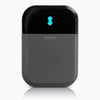
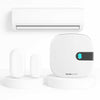
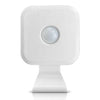
Room by room, with standalone monitors and manual thermostats, none of that scales, and after the funding cliff few districts have capital to rip out working equipment. That is the case our IAQ monitoring and smart climate control for schools platform, Sensibo Airbend, was built for, and it is our approach to improving indoor air quality in schools when the budget is operating, not capital. Airbend clips onto the air conditioners you already run, any split, PTAC, or window unit with an infrared remote, so there is no rip-and-replace and no electrician. One dashboard shows CO2, TVOC, PM2.5, temperature, and humidity per room, you set thresholds once, and the system acts on them, switching a unit to circulate and filter the air when a room crosses a limit.
The scheduling side pays the bills. Airbend runs AC on the academic calendar, powering down after the last class and easing into eco mode on weekends and holidays, so you stop cooling empty rooms all summer. The ORT educational network reported a 28% drop in its AC bill after switching to that automation. The air-quality data you gather for student health doubles as your compliance record, so one system covers comfort, spend, and an effective learning environment in the classroom at once.
FAQ
How much does it cost to improve air quality in schools?
Less than most administrators fear. Bringing a classroom up to recommended fresh-air rates runs a few dollars to about ten dollars per person a year, under 0.1% of per-pupil spending. Filters and portable purifiers cost less still, and smart retrofits skip the capital price of new equipment.
Who is responsible for classroom air quality?
The district. Managing K-12 facilities lands with school districts, which puts air quality on facilities and operations leadership rather than a state or federal agency. In practice a facility or operations manager owns the monitoring and response, while procurement and administration hold the budget for fixes.
Can you fix classroom air quality without replacing the HVAC system?
Usually, and it is the faster route. Portable HEPA units clean a single room, better filters lift particle removal building-wide, and smart controllers add monitoring, automated fresh-air response, and scheduling to the units you already run. Full replacement is the answer only when existing equipment cannot bring in enough outdoor air at any setting.
Is opening the windows enough to keep classroom air clean?
Sometimes, but not reliably. Open windows help on a mild day, yet they do nothing in a heatwave or a freeze, and they pull in outdoor particles on smoky or high-pollen days. Mechanical ventilation and filtration give you control that weather does not.