







































Key Takeaways
- Heating alone eats 42% of the energy used in U.S. education buildings, and utilities run about a quarter of district maintenance budgets.
- The GAO put 41% of districts in need of HVAC updates in half or more of their schools, roughly 36,000 buildings.
- Half of education buildings are cooled by packaged air conditioners and another 23% by residential-type units, most of which no building automation system can reach.
- Spending benchmarks are set against buildings' replacement value, 3% a year for maintenance and 4% for capital. The national shortfall runs about $85 billion annually.
- Work-order software records what broke. It does not tell you what the equipment is doing while it still works.
Ask a district facilities director how many buildings they run and you get an exact number. Ask how many pieces of climate equipment sit inside those buildings and the answer gets vague. Boilers and rooftop units are documented, because they were installed under a capital project and somebody signed for them. The window units in the annex, the mini-splits in four portables, the through-wall unit a principal bought in 2011 for the front office, those exist in a spreadsheet if they exist anywhere.
School facility management gets described as maintenance, custodial work, safety, and capital planning. Day to day it reduces to a narrower question. Do you know what your buildings are doing right now, and can you change it without sending someone to the site?
All You Need to Know About School Facility Management
- What School Facility Management Covers
- The $85 Billion Gap in School Facility Budgets
- HVAC Carries the Largest Share of School Facility Costs
- School HVAC Systems a Building Automation System Can't Reach
- Why Classrooms Run Hot When the Building Has Cooling
- Classroom Ventilation Requirements and Compliance Records
- Building a Preventive Maintenance Program for School HVAC Systems
- Energy Savings in School HVAC Without a Capital Project
- Limits of School Facility Management Software
- Sustainable School HVAC for an Aging Building Stock
- School Facility Management Metrics to Track
- FAQ
What School Facility Management Covers
School facility management is the practice of operating, maintaining, and planning for every building, system, and ground a district owns, so that classrooms stay safe and usable. It spans mechanical systems, custodial operations, regulatory compliance, energy procurement, space scheduling, and long-range capital investment. The work sits with a facilities director or business manager and is carried out by a team far smaller than the building count would suggest.
The scope divides into five domains competing for the same money and the same staff hours.
|
Domain |
What it includes |
Typical failure mode |
|
Mechanical and structural |
HVAC, plumbing, electrical, roofing, fire systems |
Reactive repair replaces planned replacement |
|
Custodial and grounds |
Cleaning, waste, landscaping, snow, pest control |
Headcount cut first when budgets tighten |
|
Compliance and safety |
Inspections, ventilation records, water testing, accessibility |
Documented only when an inspector asks |
|
Space and scheduling |
Room assignment, community use, event setup |
Buildings conditioned for occupants who never arrive |
|
Capital planning |
Condition assessment, bond sequencing, project delivery |
Sequenced by last year's breakdowns |
Staffing sets the ceiling on all of it. Of the 8 million people employed by U.S. K-12 schools in 2022, ASCE found that 4%, around 300,000, worked in building and grounds cleaning and maintenance. Pay structures make it worse. State of Our Schools documents one district that budgeted $16 an hour for HVAC technicians, could not hire at that wage, and ended up paying contractors $112 an hour for technicians the contractor paid $35.
The $85 Billion Gap in School Facility Budgets
School facilities management runs against benchmarks measured on the replacement value of the buildings, not on the district's operating budget. The 2025 State of Our Schools report sets the standard at 3% of replacement value each year for maintenance and operations, plus 4% for capital work covering renewals, deferred maintenance, and alterations.
|
Annual national figure |
Standard |
Actual |
Shortfall per student |
|
Maintenance and operations |
$104B |
$74B |
$810 |
|
Capital investment |
$138B |
$82B |
$1,526 |
Capital money also lands in the wrong place, with under 10% of total school spending reaching capital at all and 76% of that going to construction on new sites against 7% on existing structures.
Energy moves faster than any of it. Districts spend over $8 billion a year on energy, and ENERGY STAR puts more than 30% of that use in the waste column, with 10% recoverable through low-cost measures. Utility dollars leave the operating fund every month and need nobody's approval to reduce.
HVAC Carries the Largest Share of School Facility Costs
Climate equipment consumes more school energy than every other end use combined. Per the EIA's 2018 survey of commercial buildings, space heating takes 42% of end-use consumption in education buildings and cooling another 11%, against 10% or less for each remaining category including lighting and computing. It is also the system in the worst condition.
The Government Accountability Office found an estimated 41% of districts needing HVAC updates or replacements in at least half their schools, about 36,000 buildings on a deliberately conservative count, ranking above roofing, plumbing, and lighting. Roughly 65% of districts had assessed facility conditions at some point in the previous decade, which leaves a third that either had not or could not say.
School HVAC Systems a Building Automation System Can't Reach

Most guidance on HVAC systems for schools assumes a central plant with a building automation system attached. Plenty of schools have one. It rarely covers the whole campus.
CBECS data puts packaged air conditioners in half of all education buildings and residential-type air conditioners in 23%, alongside heat pumps at 20% and boilers at 30%. Those categories overlap on a single campus. A 1970s main building on a boiler, a 2004 wing on a heat pump loop, six portables on mini-splits, and a handful of window units nobody logged.
|
Equipment class |
How it's controlled |
Visible to a BAS |
|
Central plant, air handlers, VAV |
Building automation system |
Yes |
|
Rooftop packaged units |
BAS or wall thermostat |
Usually |
|
Unit ventilators |
Local or wired thermostat |
Sometimes |
|
Ductless mini-splits |
Infrared handheld remote |
No |
|
Window and through-wall units |
Infrared remote or manual dial |
No |
The bottom two rows are where district oversight ends. A handheld remote has no schedule, no lockout, and no logging, so nothing reports the unit that ran all weekend at 65°F in an empty portable. We covered what each system type costs to run and maintain in our breakdown of air conditioning systems for schools.
Why Classrooms Run Hot When the Building Has Cooling
Temperature complaints get blamed on the weather. The building is the better predictor. Orientation, glazing, occupancy density, and equipment sizing decide how a room behaves, which is why two classrooms on the same corridor served by the same system can sit four degrees apart at 1 p.m. The effects reach test performance and attendance, which we covered in how classroom temperature and air quality affect student performance.
Detection is the operational problem, since a room that runs hot every afternoon generates a complaint on the days someone calls and no record otherwise. Without per-room logging, the work order closes as "no fault found" and the pattern never surfaces.
Classroom Ventilation Requirements and Compliance Records
ASHRAE Standard 62.1 sets minimum outdoor air rates, adopted by reference into the International Mechanical Code and most state codes. Each space combines a per-person rate with a per-square-foot rate, and the assumed occupant density is what separates the two classroom bands.
|
Space type |
Per person |
Per square foot |
Default density per 1,000 sq ft |
|
Classroom, ages 5 to 8 |
10 cfm |
0.12 cfm |
25 |
|
Classroom, ages 9 and older |
10 cfm |
0.12 cfm |
35 |
|
Gymnasium, playing floor |
20 cfm |
0.06 cfm |
7 |
|
Science laboratory |
10 cfm |
0.18 cfm |
25 |
A 755-square-foot classroom with 18 students needs roughly 271 cfm at the breathing zone. Ceiling-supplied warm air pushes the required intake about 25% higher.
Design compliance and operating compliance are different things, and a system commissioned correctly in 2009 with a dirty coil, a stuck economizer damper, and a manually closed outdoor air damper delivers a fraction of its design rate with nothing in the building reporting it.
CO₂ and PM2.5 Monitoring
Carbon dioxide works as a ventilation proxy because occupants produce it at a predictable rate, so levels climbing through a class period point to outdoor air falling short of the load. Particulate readings cover filtration performance and infiltration instead. Our guide to indoor air quality in schools covers what to measure and what the readings mean.
States increasingly ask for operating records, and continuous logging turns an inspection into a data export.
Building a Preventive Maintenance Program for School HVAC Systems

ANSI/ASHRAE/ACCA Standard 180 sets minimum inspection and maintenance practice for commercial HVAC and gives districts a basis for a program that survives staff turnover.
- Inventory every unit, including the ones nobody installed on purpose. Make, model, location, install year, refrigerant. Portables and annexes first, since those assets go missing most often.
- Rate each unit's condition. Good, fair, poor, critical, applied consistently. This feeds capital sequencing.
- Set task frequency by equipment class. Filters, coils, belts, drains, dampers, and controls run on different intervals.
- Write the schedule into the work-order system as recurring tasks. Preventive work held in someone's memory leaves when they retire.
- Report the completion rate monthly. A program sitting at 60% is failing quietly.
|
Task |
Typical frequency |
|
Filter inspection and replacement |
Monthly to quarterly, load dependent |
|
Condenser and evaporator coil cleaning |
Annually, twice yearly in high-dust sites |
|
Condensate drain and pan |
Quarterly during cooling season |
|
Economizer and outdoor air damper |
Twice yearly, before heating and cooling seasons |
|
Belt tension and bearing check |
Quarterly |
|
Refrigerant charge verification |
Annually |
|
Control and sensor calibration |
Annually |
Filters earn more attention than their price suggests, because restricted airflow drives coil freezing, blower strain, short cycling, and eventually compressor failure, all from a part costing a few dollars.
Energy Savings in School HVAC Without a Capital Project

Budget conversations about HVAC for schools default to replacement. New equipment is often the right answer and always a slow one. In the meantime, most school HVAC systems waste energy on schedule gaps long before efficiency becomes the limit.
School buildings sit empty for most of the calendar. Nights, weekends, holidays, and roughly ten weeks of summer put a building well past half the year running climate control against nobody. Equipment on a handheld remote holds whatever setpoint the last person in the room chose until somebody returns.
Scheduling, setpoint policy, and occupancy response recover consumption without touching the equipment. We go deeper on measures and payback in our guide to HVAC systems for schools.
Limits of School Facility Management Software
School facility management software usually means a CMMS, which handles work orders, asset records, preventive schedules, and labor. Larger districts add an IWMS for space and capital planning. Both are useful and both share a limitation.
|
System type |
What it manages |
What it can't see |
|
CMMS / work orders |
Requests, PM schedules, labor, parts, asset history |
Equipment state between service events |
|
IWMS / CAFM |
Space, leases, capital projects, condition data |
Real-time mechanical operation |
|
Building automation system |
Central plant, air handlers, connected rooftop units |
Anything on an infrared remote |
|
Device-level control layer |
Individual AC and heat pump units, per-room conditions |
Boilers, chillers, ducted central plant |
A CMMS records that a unit failed. A BAS controls the equipment it was wired to during construction. Neither covers the ductless and window units that CBECS puts in the majority of education buildings, so a district can run two software systems and still not know what half its climate equipment is doing.
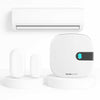
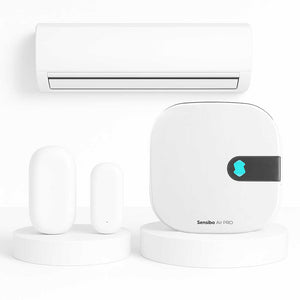
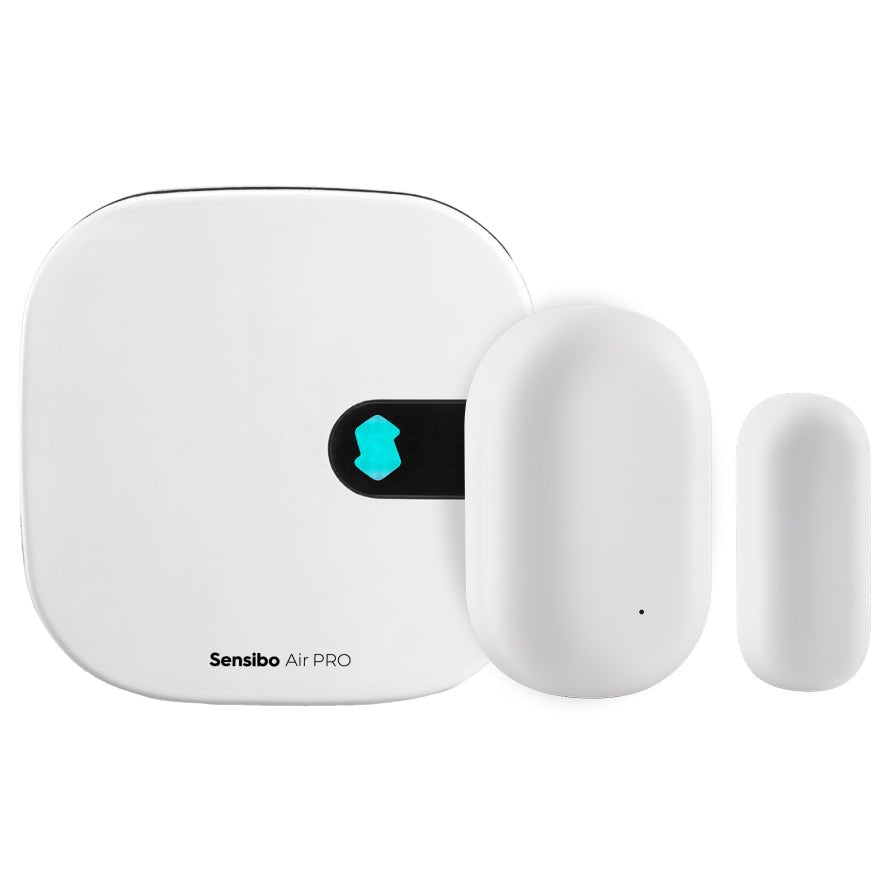
Our smart HVAC management platform for schools and campuses closes that gap without rewiring, controlling infrared-operated AC and heat pump units from one dashboard with scheduling, setpoint limits, occupancy response, per-room temperature and air quality logging, and bulk control across buildings. Sensibo reports energy savings of up to 40% for sites moving from unmanaged units to scheduled operation.
The limit is scope, since classrooms on wall thermostats, unit ventilators, or ducted central plant sit outside what an infrared controller reaches and still need BAS coverage.

Sustainable School HVAC for an Aging Building Stock
Districts work against emissions targets set by a state, a board, or a bond commitment, using building stock mostly put up decades ago. Electrification through heat pumps is the direction of travel, and CBECS already shows heat pumps in 20% of education buildings.
Sequencing is where this goes wrong, since replacing a working gas boiler early consumes capital that would deliver more reduction spent on envelope work and controls across a dozen buildings. Metering first and replacing second tends to beat the reverse. We take that apart in our piece on sustainable school HVAC.
School Facility Management Metrics to Track
- Facility Condition Index. Deferred maintenance cost divided by current replacement value, per building. Converts a maintenance conversation into a debt conversation.
- Energy Use Intensity. Site energy per square foot per year, benchmarked in ENERGY STAR Portfolio Manager. The 2018 education mean was 62.7 thousand Btu per square foot.
- Preventive maintenance completion rate. Scheduled tasks finished on time, as a percentage.
- Deferred work-order backlog. Every work order closed as deferred, held in a running total with an estimated cost.
- CO₂ exceedance hours. Occupied hours per room above your threshold, which doubles as compliance evidence.
The first move costs less than a capital request. Walk the inventory and mark each unit by what controls it, a building automation system, a wall thermostat, or a handheld remote. That column tells you how much of your campus runs on nobody's schedule, and it takes an afternoon rather than a bond cycle. For the units in that last column, Sensibo Airbend for Schools is what we built.
FAQ
Who is responsible for school facility management in a district?
Typically a facilities director or director of operations, reporting to a business manager or assistant superintendent. In small districts the role is often combined with transportation or food service, and at the smallest it sits with the superintendent.
How much does school facility management software cost?
CMMS pricing for K-12 generally runs per user or per building, with district-wide deployments commonly landing in the low tens of thousands annually. Cost scales with modules, so work orders and asset records sit well below what capital planning and space scheduling add.
Can smart controls be added to school HVAC systems without a construction project?
Yes for equipment operated by an infrared remote, covering mini-splits, window units, and most through-wall units. Controllers mount near the unit, pair with the existing remote signal, and need power and Wi-Fi, no conduit. Wall-thermostat and unit-ventilator classrooms need a different approach.
What temperature should classrooms be kept at?
Most districts target the mid-70s Fahrenheit in cooling season and around 70 in heating season. Holding the setpoint matters more than the exact number, since rooms that swing several degrees within a class period draw more complaints than rooms sitting steadily a degree off.
How often should school HVAC filters be changed?
Monthly to quarterly depending on filter type, occupancy, and local dust load. Districts running high-MERV filtration should go by pressure drop, since higher-efficiency media loads faster.