






























Key Takeaways
- Commercial building HVAC systems account for a third to half of total energy costs, making climate control the highest-impact target for operational savings
- Smart HVAC platforms deliver 20 to 40% energy reduction by adding a centralized software layer to existing equipment, through automated scheduling, occupancy logic, and policy enforcement
- Most buildings do not need equipment replacement. A smart retrofit achieves the bulk of efficiency gains at a fraction of the cost
- Multi-site operators benefit from cloud-based platforms that standardize policies across portfolios while still allowing local flexibility
- Integration with a BMS extends smart HVAC data into broader building automation, and open APIs keep the system compatible with property management software
Heating and cooling eat 34 to 44% of the energy bill in a typical commercial building, according to the U.S. Department of Energy. For a 50,000-square-foot office, that can mean $40,000 to $80,000 per year on climate control alone. Yet most facility managers still run their commercial building HVAC systems the way they did a decade ago, with scattered thermostats on walls, maintenance techs walking floor to floor, and spreadsheets tracking utility invoices weeks after the fact.
All You Need to Know About Smart HVAC Systems for Commercial Buildings
- What "Smart HVAC" Means From an Operator's Perspective
- Five Business Drivers Behind Commercial Smart HVAC Adoption
- What Climate Control Costs a Commercial Building
- Core Capabilities of a Modern Commercial HVAC Platform
- How a Commercial HVAC Management System Pays for Itself
- Scaling Climate Control Across Multiple Facilities
- Smart Control Upgrades vs. Total HVAC Replacement
- How Smart HVAC Integrates With a Building Management System (BMS)
- How to Evaluate a Commercial Smart HVAC Platform
- Sensibo Airbend, Smart HVAC Control Built for Facility Teams
- FAQ
What "Smart HVAC" Means From an Operator's Perspective
Engineers define smart HVAC through protocols and sensor networks. Facility managers care about something different. Can I see every unit across every location from one screen, set policies that enforce themselves, and prove to the CFO that last quarter's energy spend dropped?
A smart commercial HVAC system connects individual heating and cooling units (split systems, VRFs, packaged rooftops, mini-splits, window units) to a centralized software layer. That layer collects real-time data on temperature, humidity, runtime, and energy draw, then automates responses based on rules the operations team defines.
Each of these HVAC system types responds differently to smart control, but the software layer works the same way across all of them.
The gap between "smart" and "traditional" comes down to visibility and enforcement. A traditional setup leaves you with a thermostat per zone, no memory, and no reporting. A smart setup gives you a building HVAC control system that logs every runtime minute, flags anomalies, and applies scheduling and occupancy logic across hundreds of units simultaneously.
Five Business Drivers Behind Commercial Smart HVAC Adoption
1. Energy costs keep climbing, and HVAC is the largest controllable line item
Commercial electricity rates in the U.S. rose roughly 15% between 2020 and 2024. Since HVAC represents the single largest slice of a commercial building's energy consumption, a 20 to 40% reduction in runtime through automation directly hits the bottom line.
2. ESG reporting and carbon disclosure are moving from optional to mandatory
The EU's Energy Performance of Buildings Directive, updated in 2024, requires building operators to demonstrate measurable energy reduction trajectories. Several U.S. states and cities now mandate energy benchmarking for commercial buildings above certain square footage. Smart HVAC platforms that log consumption data per unit and per zone simplify compliance by generating auditable records automatically.
3. Occupant complaints drive tenant churn in commercial real estate
A 2023 BOMA (Building Owners and Managers Association) survey found that thermal comfort ranks among the top three tenant satisfaction factors in office buildings. When complaints spike, facility teams spend hours diagnosing zone-level issues. Centralized smart controls surface deviations immediately, cutting response time from hours to minutes.
4. Multi-site portfolios need standardized operations
Retail chains, hotel groups, school districts, and healthcare networks manage dozens or hundreds of locations. Each building has different equipment ages, different brands, and different local conditions. A smart commercial HVAC platform imposes consistent policies across all sites while still allowing local overrides when specific buildings need them.
5. Labor shortages make manual HVAC rounds unsustainable
Facility management teams are smaller than they were five years ago, and technician wages are rising. Sending someone to physically check 40 thermostats across three floors twice a day is expensive and unreliable. Automation replaces those rounds with continuous monitoring that catches issues a human walk-through would miss.
What Climate Control Costs a Commercial Building
|
Building Type |
Avg. Energy Use Intensity (kBtu/sq ft/yr) |
Typical HVAC Share |
Estimated Annual HVAC Cost (50,000 sq ft) |
|
Office |
65 |
33-40% |
$35,000-$55,000 |
|
Retail |
80 |
30-38% |
$40,000-$65,000 |
|
Education (K-12) |
70 |
38-44% |
$40,000-$60,000 |
|
Hotel |
95 |
40-50% |
$55,000-$85,000 |
|
Healthcare |
150+ |
40-50% |
$90,000-$140,000 |
Sources include the U.S. EIA Commercial Buildings Energy Consumption Survey (CBECS) and ENERGY STAR Portfolio Manager benchmarks. Costs assume blended U.S. commercial electricity rates.
Hotels and healthcare facilities run HVAC around the clock, pushing their bills far above offices that shut down overnight. Education buildings see dramatic seasonal swings, running near zero during summer breaks but at full demand during the school year.
Improving commercial HVAC energy efficiency starts with understanding where the waste occurs, and the numbers above show how much room there is.
The point these numbers make is consistent. The cost of HVAC for commercial buildings is not a 5 or 10% line item. It is a third to a half of the operating energy budget, and it responds to software-driven optimization better than any other category.
Core Capabilities of a Modern Commercial HVAC Platform

The features that separate a serious commercial platform from a consumer-grade smart thermostat fall into five categories.
- Centralized dashboard with multi-site visibility
- Occupancy and presence logic
- Automated scheduling and policy enforcement
- Analytics, reporting, and anomaly detection
- Open API for BMS and third-party integration
Centralized dashboard with multi-site visibility
The single-pane-of-glass view is where operators spend most of their time. A strong building HVAC control system shows the status of every connected unit, including current temperature, target temperature, operating mode, power draw, and alert flags. Map views let managers spot a malfunctioning unit in a distant branch office without leaving their desks.
Remote monitoring makes this possible even when buildings sit in different time zones.
For multi-site operators, the dashboard should allow grouping by building, floor, zone, or room type.
Occupancy and presence logic
Empty rooms do not need active climate control. The simplest version of occupancy logic is a motion sensor that triggers an "unoccupied" mode after a set idle period. More advanced setups integrate door/window sensors so the system shuts off a unit the moment a balcony door opens and resumes when it closes.
This sensor-driven response is a core feature of IoT HVAC systems, where hardware and software coordinate without human input.
In hotels, occupancy logic prevents guests from leaving the AC at 16°C (61°F) while they spend the day at the beach. In offices, it pulls back conditioning in conference rooms that sit empty 60% of the working day.
Automated scheduling and policy enforcement
Scheduling goes beyond "on at 7 AM, off at 6 PM." A mature commercial HVAC system lets operators define layered policies covering weekday vs. weekend schedules, holiday exceptions, temperature ceilings and floors, and mode restrictions. Those policies apply in bulk to device groups, so a single rule change propagates to 200 units at once.
The hardware that enables this ranges from basic programmable units to commercial WiFi thermostats with cloud connectivity and API access.
Policy enforcement matters more than policy creation. In a manual system, a single employee adjusting a thermostat undoes the energy plan for that zone. Smart enforcement restricts adjustable ranges so occupants can fine-tune comfort without defeating the energy strategy.
Analytics, reporting, and anomaly detection
Runtime logs, energy consumption graphs, and trend comparisons turn HVAC data into decisions. Operators can compare this month's consumption to the same month last year, flag units that run 30% more than their neighbors, and identify maintenance candidates before they fail.
How a Commercial HVAC Management System Pays for Itself
Energy savings as the immediate return
Smart scheduling and occupancy logic alone typically cut HVAC energy consumption by 20 to 40%. The Ort Bialik High School Network deployed centralized smart AC control across its campuses, cutting energy waste tied to after-hours and unoccupied-room runtime. Prestige Bookings, a luxury resort operator in Cyprus with 14 properties, used climate-react thresholds and motion-sensor shutoffs to stop units from running in empty guest rooms.
At those percentages, a building spending $60,000 per year on HVAC recovers $12,000 to $24,000 annually.
Labor savings through fewer walk-throughs and faster troubleshooting
Remote monitoring eliminates the daily thermostat rounds that consume 1 to 2 hours of technician time per building. When something goes wrong, the system alerts the team with a specific unit ID and fault description instead of a vague "it's too hot on the third floor" call from a tenant.
Equipment longevity from reduced stress
Short-cycling (rapid on/off switching) is one of the leading causes of compressor failure. Smart controls smooth out operation by maintaining consistent setpoints and preventing erratic manual adjustments. Units that run within designed parameters last longer before replacement, extending the useful life of capital-intensive HVAC assets.
Scaling Climate Control Across Multiple Facilities
Single-building solutions break down the moment a portfolio grows. Multi-site commercial HVAC systems need four things to scale. First, a cloud-based platform accessible from any browser. Second, brand-agnostic compatibility, because buildings acquired through expansion rarely share the same HVAC brands. Third, role-based access control that mirrors the org chart. And fourth, bulk actions that let a single rule change propagate to hundreds of units.
Smart Control Upgrades vs. Total HVAC Replacement

Most commercial buildings do not need new air conditioning hardware. The Consortium of Energy Efficiency estimates that at least 25% of commercial rooftop HVAC units are oversized, meaning the equipment has capacity to spare. The problem is how that equipment is managed, not what it is.
A full commercial HVAC replacement for a mid-size office runs $150,000 to $500,000. Smart retrofit controllers attach to existing units for a fraction of that cost, typically $100 to $250 per unit plus a modest annual software subscription.
Replacement makes sense when equipment is at end of life or when refrigerant phase-outs force the hand. For the 80%+ of buildings where existing AC hardware still has useful life, a smart control layer gets 70 to 90% of the efficiency gains at 5 to 10% of the replacement cost.
How Smart HVAC Integrates With a Building Management System (BMS)
A BMS (sometimes called a building automation system, or BAS) coordinates lighting, security, fire safety, elevators, and HVAC under one umbrella. Smart HVAC platforms do not replace a BMS; they sit alongside it or feed into it through open APIs.
For buildings without an existing BMS, a smart HVAC platform often serves as the first step toward building automation. For buildings that already run a BMS from Siemens, Honeywell, or Johnson Controls, the question is complementary functionality. Legacy BMS installations may control central plant equipment but lack per-unit visibility for distributed split ACs and mini-splits. A dedicated smart HVAC layer fills that gap without a full BMS upgrade.
How to Evaluate a Commercial Smart HVAC Platform
Before committing to a platform, facility teams should pressure-test each vendor against these requirements.
- Compatibility scope. Does the platform work with your existing AC units regardless of brand, model, or age? Look for IR compatibility covering 10,000+ models.
- Installation disruption. How long does per-unit installation take? The best commercial platforms install in minutes per device with no wiring changes.
- Multi-site architecture. Can the platform manage geographically distributed buildings from one login with organizational hierarchy (region > building > floor > zone > unit)?
- Policy and automation depth. Can you set temperature limits, scheduled on/off times, occupancy-based rules, and mode restrictions? Can policies be assigned to device groups in bulk?
- Reporting and export. Does the platform generate energy consumption reports, carbon-equivalent calculations, and compliance-ready exports?
Evaluating specific devices against these criteria is easier with a side-by-side breakdown of the best commercial smart thermostats on the market.
- Data security. Confirm that the platform encrypts data in transit and at rest, supports SSO/SAML for enterprise clients, and complies with regional data residency requirements.
- Integration capability. Does the vendor offer an open API for BMS integration, property management system connectivity, or custom automation triggers? Closed ecosystems limit future flexibility.
Sensibo Airbend, Smart HVAC Control Built for Facility Teams
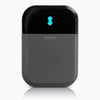
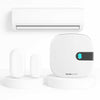
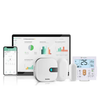
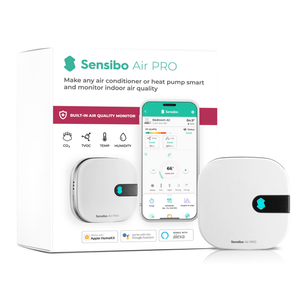
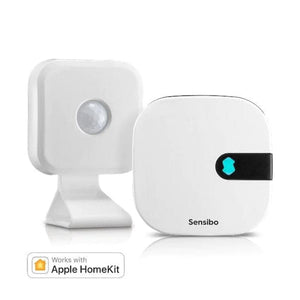
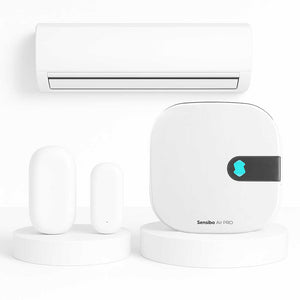
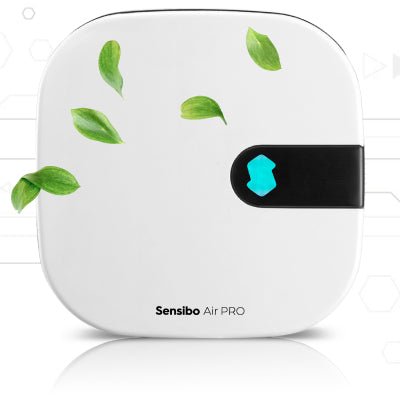
Sensibo Airbend is a commercial HVAC management platform built for the operational realities described throughout this guide. It connects to existing air conditioners and heat pumps through plug-and-play smart controllers that install in under a minute per unit, with no tools, no wiring, and no equipment replacement.
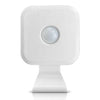
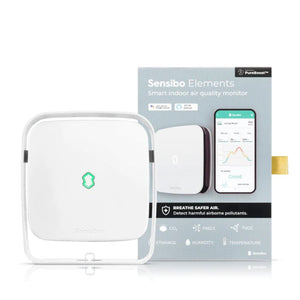
From a single cloud dashboard, facility teams manage all connected units across multiple buildings. Bulk scheduling, temperature limit enforcement, occupancy-based automation through room and door sensors, and real-time energy analytics run without manual intervention. The platform works with 10,000+ AC models from every major manufacturer.
Organizations including NEOM (Saudi Arabia), the Ort Educational Network, Prestige Bookings (luxury hospitality, Cyprus), and CSIRO (Australia's national science agency) run their climate operations through Airbend, with reported results of up to 40% reduction in energy bills.
Looking Ahead
The commercial buildings that will carry the lowest operating costs over the next decade are not the ones buying the newest HVAC hardware. They are the ones putting a smart software layer on what they already have and letting data, not habit, run the schedule. The gap between a manually managed building and a software-managed one widens every year as energy prices, labor costs, and compliance requirements all trend in the same direction.
FAQ
Can a smart HVAC platform work with my existing air conditioning units?
Yes. Platforms like Sensibo Airbend retrofit onto any air conditioner or heat pump that uses an infrared remote control. This covers split systems, mini-splits, VRFs, window units, and portable ACs across all major brands. No equipment replacement is needed.
How does data security work with a cloud-based HVAC control system?
Reputable platforms encrypt all data in transit (TLS) and at rest. Enterprise deployments should look for role-based access controls, SSO/SAML support, and compliance with regional data protection regulations (GDPR, SOC 2). Treat HVAC platform security the same way you would treat any building operations software.
Can smart HVAC integrate with our existing building management system?
Most smart commercial HVAC platforms offer open APIs that allow a BMS to pull real-time device data, energy consumption logs, and alert feeds. If your BMS manages central plant equipment but lacks visibility into distributed split systems or mini-splits, a smart HVAC layer fills that gap without requiring a BMS overhaul. Confirm API documentation with your vendor before purchasing.
What is the typical payback period for a smart HVAC retrofit?
For a building spending $50,000 or more per year on HVAC energy, a smart retrofit typically pays for itself within 6 to 18 months through reduced energy consumption alone. Labor savings and extended equipment life add further value. Buildings with high occupancy variability (hotels, schools, mixed-use) tend to see the fastest returns because the gap between "always on" and "only when needed" is largest.
How long does installation take across a large building?
Most smart controllers install in under a minute per unit with no tools, no wiring changes, and no HVAC technician required. A 100-unit office building can be fully equipped in a single day without disrupting normal operations or taking rooms offline.