




























Key Takeaways
- Check the equipment before the product page. A large share of commercial cooling gear has no thermostat terminal block, so no thermostat will control it at any price.
- ASHRAE 90.1 §6.4.3 sets hard limits on scheduling, clock backup, override, and setpoints. Plenty of consumer WiFi models miss at least one.
- Talk to IT before you shortlist. A device that can't authenticate to an enterprise WLAN never leaves the box, whatever it does on the HVAC side.
- ENERGY STAR certifies connected thermostats against a year of field data from homes. No commercial equivalent exists, so the label proves nothing about a 200-unit office.
- Hardware is the smallest line across a fleet. Install labor, per-device licensing, and network work decide the real number.
A commercial WiFi thermostat rarely fails on the HVAC side. It fails when IT refuses to put it on the network, when a plan reviewer catches a code miss, or when the second year of per-device licensing lands on a budget nobody warned you about.
Vendors sell the dashboard. Buyers live with the wiring, the network policy, the code review, and a cost model that runs well past the invoice.
Around 55% of U.S. commercial buildings with cooling run packaged air-conditioning units, and many of those same buildings also run PTACs and mini-splits that no thermostat can reach. That mix is where most procurement mistakes start.
All You Need to Know About Commercial WiFi Thermostats
- Start With What Your Equipment Can Physically Accept
- Not Every Commercial Thermostat Connects the Same Way
- The Code Requirements Most Product Pages Skip
- What Your IT Team Will Ask Before Anything Goes on the Network
- What Happens When the Connection Drops
- Total Cost of a Commercial Thermostat Fleet
- What to Ask Before You Sign
- FAQ
Start With What Your Equipment Can Physically Accept
Walk the building with a screwdriver before you open a browser tab. A commercial thermostat lands on a 24VAC terminal block, and that block either exists or it doesn't. Rooftop packaged units and commercial split systems have one, usually behind a wall stat you can pull off its subbase in ten seconds. PTACs, ductless mini-splits, window units, and portable ACs mostly don't, because they take their commands from a handheld infrared remote and have no wall stat at all.
|
Equipment type |
Control interface |
What you're shopping for |
|
Rooftop packaged unit (RTU) |
24VAC terminal block, usually multi-stage |
Commercial wired thermostat with WiFi |
|
Commercial split system |
24VAC terminal block |
Commercial wired thermostat with WiFi |
|
PTAC, mini-split, window, portable |
Infrared remote, no terminal block |
IR controller |
|
VRF indoor head |
Manufacturer bus or IR, varies by model |
Confirm per model before ordering |
|
Electric baseboard, radiant |
Line voltage at 120V, 208V, or 240V |
Line-voltage thermostat, not a 24VAC unit |
Most buildings run more than one row of that table. A hotel with rooftop units over the lobby and PTACs in every guest room needs two control paths, which usually means two vendors, two trades doing the install, and two lines in the capital request. If the nameplate data is thin or the equipment predates anyone currently on staff, our breakdown of the types of HVAC systems for commercial buildings covers how each category is normally controlled.
Not Every Commercial Thermostat Connects the Same Way

Three architectures share the same shelf, separated by what carries the control signal versus what carries the data. Getting those two confused is why "commercial wireless thermostat" as a search term returns underfloor heating guides written for homeowners.
Wire to the Equipment, WiFi to the Cloud
The default, and what most people mean by a commercial WiFi thermostat. Low-voltage wiring runs from the thermostat to the equipment exactly as it always did, and WiFi carries scheduling, monitoring, and alerts to a cloud dashboard. The control path never depends on the radio, so the unit keeps running its schedule through a network outage and loses only remote access.
Commercial models in this category carry terminals residential units don't, and three are worth confirming before you order.
- An economizer output opens the outside-air damper for free cooling when the weather cooperates.
- A digital input lets a door contact or security panel drop the space to unoccupied without anyone touching the schedule.
- And remote sensor inputs stop one thermostat on a sunlit wall from freezing the rest of the floor.
Stage counts run to 4 heat and 2 cool. Buildings with existing automation should confirm BACnet MS/TP or BACnet IP support here, since that's what a building management system speaks.
A Private Mesh Instead of Building WiFi
Some commercial systems skip building WiFi entirely and run a private RF mesh between thermostats and a gateway. The argument for a commercial wireless thermostat on its own mesh is coverage. WiFi in a finished office suite is fine. WiFi in a mechanical room behind a steel door, at the far end of a warehouse, or on a roof often isn't. A thermostat that drops off the network every afternoon still generates the comfort complaint, and you drive out to find the unit sitting on the wall running its schedule correctly.
The tradeoff is a second network to own and a gateway that becomes a single point of failure per site. When it drops, you lose visibility on every thermostat at that location at once.
Infrared Control
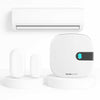
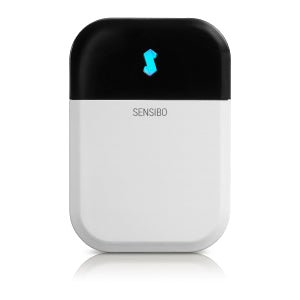
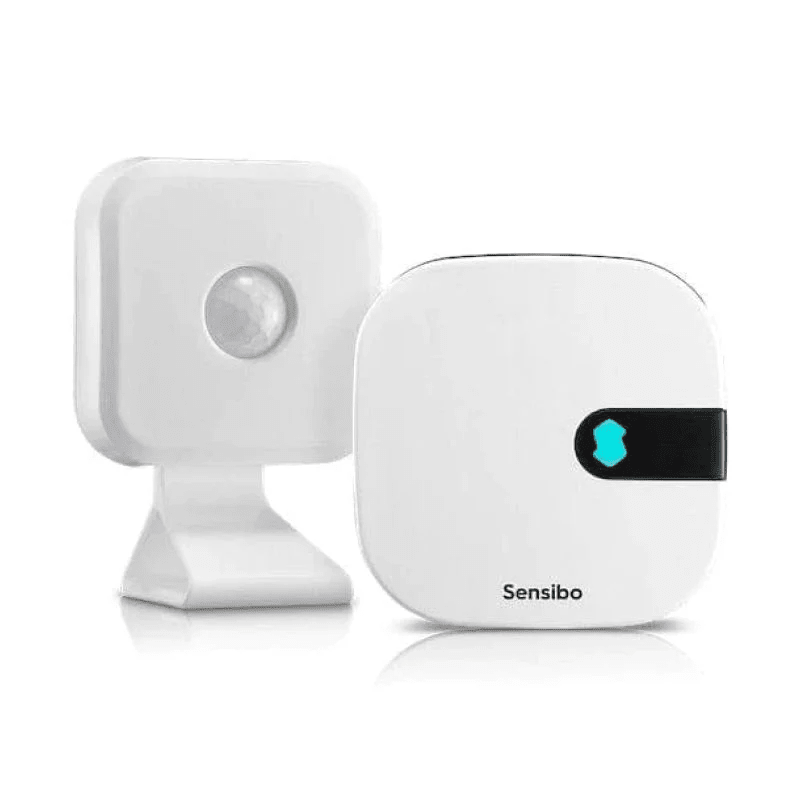
For equipment with no terminal block, control comes from a small device placed within line of sight of the indoor unit, reproducing the commands the handheld remote sends. It isn't a thermostat, and calling it one during install causes confusion with mechanical contractors who expect to be pulling wire.
What it buys you is a network layer on equipment that had none. For a retail chain or a hotel running hundreds of IR-controlled units, the only other route to central control is replacing the AC itself.
The Code Requirements Most Product Pages Skip
ASHRAE Standard 90.1 governs controls in most U.S. commercial construction, and §6.4.3 narrows thermostat selection for you. Six of them decide most shortlists. A device that misses any of them creates a problem at plan review or when a retrofit permit gets examined, and product marketing almost never mentions them.
|
Requirement |
Clause |
Check the datasheet for |
|
Scheduling for seven different day types per week |
"7-day" programming, not 5-1-1 or 5-2 |
|
|
Programming and time retained through a power loss of at least 10 hours |
§6.4.3.3.1 |
Clock backup duration |
|
Accessible manual override limited to 2 hours |
§6.4.3.3.1 |
Temporary hold behavior and cap |
|
Deadband of at least 5°F (2.8°C) between heating and cooling setpoints |
§6.4.3.1.2 |
Minimum adjustable deadband |
|
Unoccupied heating setback of at least 10°F (5.6°C) below occupied |
§6.4.3.3.2 |
Unoccupied setpoint range |
|
Unoccupied cooling setup of at least 5°F (2.8°C) above occupied |
§6.4.3.3.2 |
Unoccupied setpoint range |
Occupant sensors, manual timers, and a security system interlock are permitted alternatives to the scheduling requirement, which matters for spaces with unpredictable hours. Addendum c to 90.1-2022 also tightened how setpoints get displayed on devices that change over automatically between heating and cooling. On those systems an occupant adjusting one setpoint moves both, so a narrow deadband turns a small nudge into a heating call and a cooling call in the same hour.
ENERGY STAR isn't a shortcut here. Its connected thermostat criteria certify savings against a year of anonymized field data gathered from homes, and nothing equivalent exists for commercial buildings. One of those criteria is worth borrowing anyway. The device has to keep working as a basic thermostat when it can't reach the service.
What Your IT Team Will Ask Before Anything Goes on the Network
Consumer hardware washes out here. Commercial thermostat WiFi support gets one line on a product page and a week of argument during deployment. Google's support documentation states that Nest products don't work with captive portal networks and that enterprise 802.1X/RADIUS networks aren't compatible. Most corporate WiFi runs 802.1X. Google also notes you can't sign into the Nest app with a Workspace account, which puts fleet access on somebody's personal login.
Send these to the vendor ahead of the pilot.
- Does it support 802.1X or personal-mode WPA only, and which bands does the radio use?
- Can it get through a captive portal, or does it need an SSID without one?
- Which VLAN will it sit on, and what needs to reach it?
- What outbound destinations and ports does the cloud service require?
- How does firmware update, and can rollouts be staged rather than pushed at once?
- Is MAC allowlisting supported, and can MAC addresses be supplied in bulk before delivery?
- How many devices will land on each access point once the fleet is live?
- Can the management console authenticate against our identity provider instead of standalone logins?
- Who holds credentials, including the installing contractor, and how do you revoke them?
Contractor Access Is Part of the Purchase
In 2013, attackers reached Target's network using credentials taken from an HVAC contractor, Fazio Mechanical Services. From there they moved laterally to point-of-sale systems in Target stores nationwide, exposing about 40 million payment cards. Both the reporting that first identified the vendor and the Senate Commerce Committee's kill-chain analysis are clear about the mechanism. The way in was a vendor portal rather than a thermostat, and flat network design let the intrusion travel once it was inside.
Any cloud-connected control system adds accounts, and some of them belong to people outside your organization. Ask for per-user credentials rather than a shared vendor login, permissions that stop a service tech from exporting a portfolio-wide site list, and a documented offboarding process for the day the contract ends.
What Happens When the Connection Drops

Two failure modes on different clocks.
The short one is an outage. Ask what the device does at hour three of a WAN failure. A wired thermostat with a local clock keeps running its programmed schedule and loses only remote visibility. Some cloud-first designs hold whatever state they were last in, and a retail chain that holds "occupied" across a long weekend pays for the difference in one bill.
The long one is the vendor. Google unpaired first and second generation Nest Learning Thermostats from the Nest and Home apps on 25 October 2025. The hardware still works on the wall. Remote control, notifications, app-pushed schedules, and third-party integrations stopped. Anyone who had standardized a portfolio on those units either replaced the fleet or went back to walking floors with a clipboard.
Cloud-dependent hardware carries a support horizon that nobody prints on the box, and a vendor with no published end-of-life policy is quietly asking you to absorb that risk.
Total Cost of a Commercial Thermostat Fleet
Hardware gets quoted per device, and that's the number most people compare. Across a fleet of two hundred, it rarely decides the budget.
|
Cost line |
What drives it |
Easy to miss because |
|
Hardware |
Device count, feature tier |
It's the only number on the quote |
|
Install labor |
Wiring changes, panel access, ladder work, electrician or not |
Quoted per site, not per device |
|
Subscription or licensing |
Per device, per month, multiplied by contract years |
Year one is often discounted |
|
Network build-out |
AP density, VLAN work, certificate handling |
Sits in the IT budget, not facilities |
|
Spares |
Failure rate across the fleet, replacement lead times |
Nobody stocks until the first failure |
|
Training and handover |
Turnover in the operations team |
Assumed to be free |
|
Decommissioning |
Data export, account closure, disposal |
Nobody thinks about it at purchase |
Rebates and Demand Response Credits
Commercial thermostat incentives exist, and they're smaller and more local than the residential programs that dominate search results. Energize Connecticut runs a commercial thermostat incentive worth up to $85 per qualifying unit, with instant rebates available through participating distributors. Arizona Public Service pays business customers a $60 enrollment credit per thermostat to join Cool Rewards Business, plus $40 per thermostat annually for staying enrolled. DSIRE is the fastest way to find what your own utility offers.
Programs that pay for demand response participation need the platform to accept a curtailment signal. OpenADR 2.0b, standardized internationally as IEC 62746-10-1, is what most of them use, so it belongs on the spec sheet even if enrollment isn't happening in year one.
What to Ask Before You Sign
Nine questions about the contract rather than the hardware.
- Which of our equipment types can this control, and which can't it?
- What does this same deployment cost in year three, not year one?
- What happens to installed hardware if we don't renew the subscription?
- Can we export our data, in what format, and does that survive termination?
- What's your published end-of-support policy and notice period?
- Who provides first-line support, and during which hours in our time zones?
- What's the RMA turnaround on a failed unit, and do you stock spares in our region?
- Can you give us three references at similar unit count on similar equipment?
- Can we run a ten-unit pilot on a live site before committing?
Then Run the Pilot
Question nine matters more than the other eight. Buy ten, install them on the worst site you have (marginal WiFi, oldest equipment, least patient staff), and run them through a full cooling season.
Measure three things. Connection uptime. How many service calls the install generated. How long it takes an operations person to change a schedule across all ten. Our guide to smart HVAC for commercial buildings covers what to check at the platform layer once the hardware clears.
What It Looks Like at 300 Sites
7-Eleven Hong Kong hit the equipment fork at chain scale. Stores across the territory run split systems on infrared remotes, and staff were adjusting units by hand with no visibility from head office. Working with City FM Asia on regional deployment, the chain brought more than 300 stores onto centralized HVAC control, replacing manual adjustment with occupancy-driven automation and cutting AC-related energy use across the estate.

That's the gap we built Airbend for. If your portfolio mixes mini-splits and PTACs with ducted equipment, we're happy to walk through what both look like on one dashboard.
FAQ
How Many WiFi Thermostats Can One Access Point Handle?
Far fewer than the datasheet promises. Enterprise access points advertise hundreds of clients per radio, but plan on a few dozen in a real building. Thermostats send almost no data, so what runs out is association slots and 2.4 GHz airtime rather than bandwidth. A hotel adding 200 room controllers is adding 200 devices to a network sized for guest phones.
Who Installs Them, the HVAC Contractor or the IT Team?
Both, in sequence, and the handoff is where projects stall. A wired thermostat needs a mechanical contractor for the terminal connections and equipment configuration, then IT to get it onto the network. IR controllers skip the mechanical step, which is why ours usually go in by facilities staff. Agree who owns commissioning before the boxes arrive.
How Do Schedules Handle Time Zones Across Multiple Sites?
A platform worth buying stores them in local time per site, so daylight saving and multi-region portfolios take care of themselves. One clock applied across every location shifts every schedule twice a year, and you find out when a store starts conditioning at four in the morning.
Does a Third-Party Thermostat Void the HVAC Manufacturer's Warranty?
Usually not on conventional 24VAC control, since that interface is open and documented. Proprietary communicating systems are the exception, because the manufacturer's own controller counts as part of the certified assembly and the warranty excludes parts they didn't supply. Most warranties also require a licensed installer. Read the certificate before anything gets swapped.
In a Leased Space, Who Controls the Thermostat?
The lease does. A tenant holding the utility account on separately metered space normally controls setpoints. Where the landlord supplies conditioned air as part of base rent, control stays with building management.
What Temperature Should a Commercial Building Be Set To?
There's no legal number. OSHA has no regulation covering office temperature and recommends 68°F to 76°F (20°C to 24°C) at 20% to 60% relative humidity, pointing to ASHRAE Standard 55. The occupied setpoint is yours to decide on comfort and policy grounds.