






































Key Takeaways
- The schedule is the fastest free change you can make. Low effort, 7.1% of site energy nationally.
- Widening the gap between heating and cooling setpoints, then letting it drift further after hours, tops the national list at 7.8%. It's the single best measure in elementary buildings.
- High schools are a different problem. Ventilation drives their bill harder than setpoints do.
- A full package of these changes models out at 49% for secondary schools, higher than any other building type.
- Commissioning runs a median $0.26 per square foot and pays back in 1.7 years. Pair it with monitoring and the savings roughly double.
You know how the replacement conversation goes. Somebody brings a number to the board, the board asks what it does to the tax rate, and the project lands in a bond cycle three years out. They're not wrong. 41% of districts need HVAC work in half or more of their schools.
The equipment gets replaced eventually. Between now and then it runs on a schedule and a setpoint, and in most buildings we walk into, both are wrong. The fan schedule got stretched for the custodial crew a decade ago and never came back. Nobody logged it, so nobody knows to undo it. Energy models treat twenty hours of weekday fan runtime as the realistic starting point for a school, with four of those hours counted as a fault before a single component has failed.
All You Need to Know About Cutting School HVAC Energy Costs
- Six Changes That Save Without New Equipment
- Fix the Schedule Before You Touch Anything Else
- Setpoints, Deadbands, and the Complaint You'll Get
- Ventilation Is Where a High School's Gas Bill Goes
- Three Faults Nobody Writes a Work Order For
- How Long Control Savings Last
- The Units That Answer Only to a Remote
- Paying for It Without a Bond
- FAQ
Six Changes That Save Without New Equipment
Settings account for most of what HVAC systems for schools waste. Thirty-four control measures have been modeled across 16 climate zones and nine building types, two of them schools. Six cleared 2% site energy savings nationally, weighted for how often the opportunity exists at all. All six are controls changes, and the last column is what each one needs beyond that.
|
Change |
What you're changing |
Site savings |
Also needs |
|
Wider deadbands with night setback |
The gap between heating and cooling setpoints, and how far it drifts after hours |
7.8% |
Nothing |
|
Shortened HVAC schedules |
Fan and conditioning hours, back to real occupancy |
7.1% |
Nothing |
|
Demand control ventilation |
Outdoor air driven by measured CO2 instead of design headcount |
7.1% |
CO2 sensors, commissioned against minimum rates |
|
Reduced minimum VAV box flow |
The floor on terminal box airflow, which cuts reheat |
6.5% |
VAV terminal boxes |
|
Optimal start |
Warm-up time calculated daily instead of a fixed lead |
5.9% |
Nothing |
|
Supply air temperature reset |
Supply temperature raised when the load allows |
2.5% |
Sensor verification |
Four of those six are rated low-effort in the modeling. A seventh belongs in a footnote rather than the table. Advanced rooftop fan controls save 4.0% of baseline electricity, more than any measure studied. Total site savings come to 1.3%, because the fan heat you stop generating is heat the boiler has to make instead. On boilers, price that one off the electric bill alone and the gas line takes the savings back.
Rooftops still deserve the attention, since they run your gyms and cafeterias. Retrofitting them with advanced controllers cut unit electricity 22% to 91%, averaging 56% across 66 units in a 2013 Department of Energy field test. Payback scales with your electricity rate: six years near $0.05 per kWh, three at $0.10, two at $0.15. Look up your own rate before anyone quotes you a generic figure.
Fix the Schedule Before You Touch Anything Else

Nothing else costs this little or moves this fast. It's also the setting most likely to have gone wrong already, and it goes wrong the same way from district to district.
Where the Hours Go
- Custodial. The bell schedule ends at 3:10 and the crew works till 11:00. The fan schedule got pushed out to reach them. It reaches the whole building, not the two wings anyone is cleaning that night.
- Athletics and community use. Rec league Tuesdays and Thursdays in the gym, which wakes three classroom wings.
- Evening meetings. A board meeting the second Monday of the month, permanently baked into the base hours rather than run as an exception.
- Summer programs. Six weeks of classes spread thin across three sites, in spaces nobody mapped before the calendar was set.
All four are real reasons to condition a space. Each one currently conditions a building when it only needs a room.
Building a Schedule That Survives the Year
- Pull the real occupancy calendar. Custodial shifts, athletics, community bookings, adult ed, summer programs. Get it from whoever books the rooms, not from the front office calendar.
- Set the base to the tightest common case. Start at your earliest regular arrival, less the time the place needs to come up to temperature. Stop at the last classroom departure. Everything past that becomes an exception.
- Write exceptions per zone. An adult-ed class in two rooms should condition two rooms. Stretch the base hours to cover it instead and you've bought conditioning for the whole floor.
- Consolidate summer. Programs pulled into a single wing run one building instead of three. That call gets made in April by somebody who has never seen a utility bill, and it's worth more than most of the control measures you could buy.
- Date the review. Terms shift and programs move. A schedule nobody revisits only ever grows.
- Check the meter a month later. If the overnight baseline didn't drop, the schedule isn't running, and you've found something more interesting than a timer.
Setpoints, Deadbands, and the Complaint You'll Get
Most schools hold cooling in the mid-70s°F (around 24°C) and heating near 70°F (21°C). Those numbers are defensible. What happens around them usually isn't. Individual rooms get set tighter than the written policy allows, so equipment on the same loop heats and cools against itself. And when the building empties, nothing widens at all. Energy models let an empty school drift to 65°F (18°C) and 80°F (27°C), a setback almost no district takes.
Widen the band and you'll hear about it, though not from everyone.
The Override Problem
Complaints cluster in the same rooms year after year. Southwest corner, top floor, thirty bodies and a bank of glass at 1pm. Those teachers aren't imagining it. Same system, same corridor, and the room sits three or four degrees off its neighbor.
What happens next is predictable. The setpoint gets pushed to 65°F to force the unit to run. The space heater comes out in January when the same room runs cold all morning. Neither generates a work order, so the pattern stays invisible until you have per-room temperature logging and can finally separate a comfort problem from a control problem.
Our advice, and this is judgment rather than research: widen the deadband everywhere except the rooms you already know about, and handle those individually. A blanket setpoint policy dies the first week a corner classroom hits 79°F.
Ventilation Is Where a High School's Gas Bill Goes

Elementary and secondary buildings don't respond the same way, which matters when you're picking a starting point.
Elementary buildings do best on wider deadbands with night setback, on both fuels. High schools do best on shortened schedules for electricity and demand control ventilation for gas, where it reaches 25.5%.
Density explains it. A secondary school averages 31.7 square feet per person against roughly 200 in an office. The gas goes into conditioning outdoor air for a headcount that seldom arrives in full. Tie that damper to a CO2 sensor and you beat anything setpoints will give you.
High schools also model out at 49% overall from a full package, ahead of every other building type. Eleven of the fourteen types studied landed between 23% and 29%.
One line item most districts underprice: demand charges. Utilities bill many schools for kilowatts alongside kilowatt-hours, and the demand portion can pass 30% of the electric cost. Yours lands on the first hot afternoon of May with every unit calling at once, and a package of demand response measures trims that spike by 19%. That's a bill reduction that doesn't require saving a single kilowatt-hour.
Three Faults Nobody Writes a Work Order For
Energy models build three faults into every school they simulate. How often they show up in real school HVAC systems, nobody has measured, and the researchers say so plainly. What the three have in common is that none produces a symptom anyone reports.
|
Fault |
How it presents |
What it costs you |
|
Outdoor and return air sensors drifting |
Nothing. The unit runs and holds temperature |
A 3°F bias locks the economizer out of free cooling on days that qualify for it |
|
Dampers that don't seal |
Nothing in summer, high gas bills in winter |
Ventilation range capped near 70% in modeling, and conditioned air leaks past a damper that reads as shut |
|
Low refrigerant charge |
"The unit can't keep up anymore" |
10% off efficiency and 20% off capacity, misread as an aging unit near replacement |
Low charge is the expensive one. Equipment that can't hold a classroom on a hot afternoon reads as end-of-life, and it goes into the capital plan on that basis. Charge verification costs a service call.
The check is seasonal and it's the same visit each time. Put a handheld on the outdoor and return air sensors and compare readings; drive the economizer damper through its full stroke and confirm it moves; verify charge against superheat and subcooling instead of gauge pressure alone. Twice a year, ahead of each season.
How Long Control Savings Last
Setpoints get pushed. Schedules get extended for an evening event and never pulled back. A sensor drifts and the economizer stops economizing without telling anyone.
Across roughly 1,500 buildings, median savings varied by how the work was delivered rather than by building type or size. Standard utility program work returned 5%. Submetering and ongoing diagnostics pushed the median to 9%. Projects run outside utility programs, usually with wider scope, reached 14%. Median cost across all of it was $0.26 per square foot, median payback 1.7 years. The measures were much the same in each case; what varied was how long anything kept watching.
What to Report and How Often
Pull twelve months of utility data before you change anything, and normalize against heating and cooling degree days so a mild winter doesn't get credited to your work. Then track energy use per square foot monthly against that baseline, site by site. Across a district it's what lets you put campuses next to each other. Run HVAC for schools without it and you're managing on complaint volume.
When a site's reading walks back toward where it started, somebody has overridden something, and you find out in weeks instead of at the next audit. That monthly figure is also the only part of this a business manager will ever read. Our guide to monitoring and managing school facilities goes further into what to track.
The Units That Answer Only to a Remote

None of it matters if nothing can reach the equipment. A building automation system reaches most of it, and fewer campuses have that coverage than the sales conversation implies. On the last national count, over 85% of commercial buildings still ran on time clocks, wall thermostats, and manual switches.
Then there's the rest of the fleet. Ductless heads in the portables, PTACs down an older corridor, a window unit in the band room, whatever went into the front office the year a principal got tired of asking for one. Those answer to a handheld infrared remote, and a remote has no clock and keeps no record. Scheduling, deadbands, and setback are all unavailable on the equipment sitting closest to students. We broke down what each of these costs to run in our guide to air conditioning systems for schools.
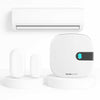
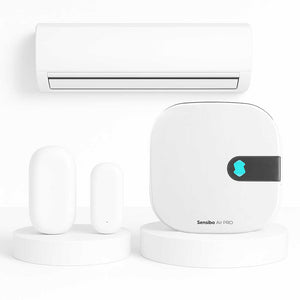
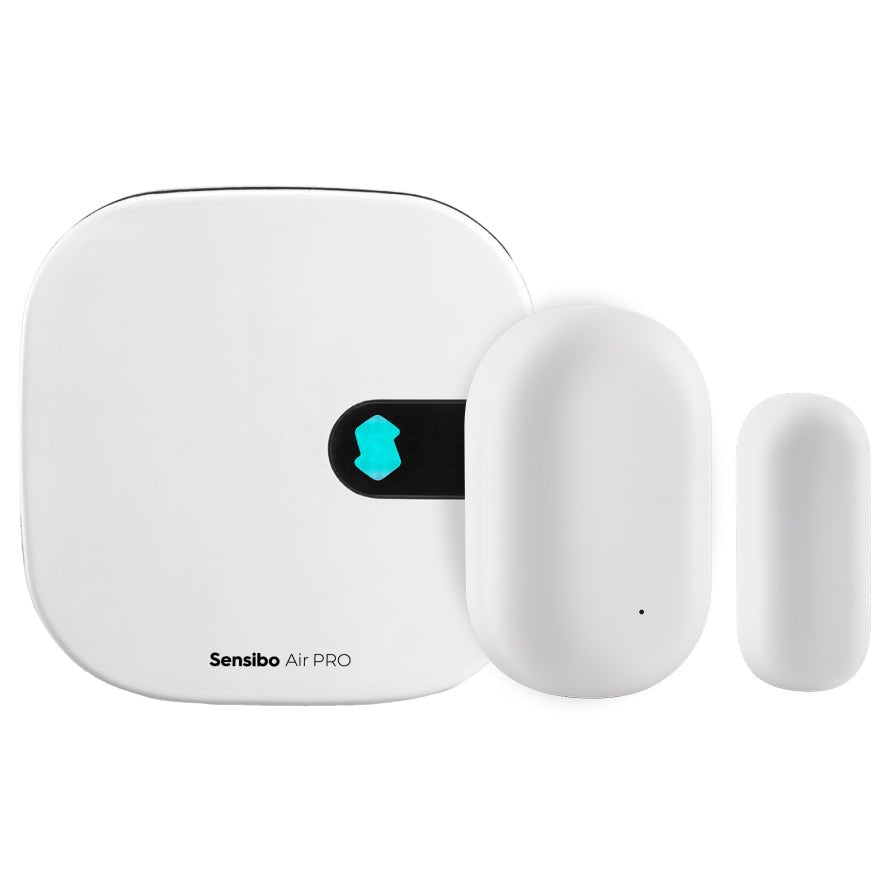
School HVAC control at that layer needs a controller that speaks infrared. That's what we built Sensibo Airbend for. It puts those units on one dashboard with term-based scheduling, per-room setpoint limits, and occupancy response. The per-room temperature and CO2 logging is what finally makes the corner-classroom problem visible. ORT Bialik ran it across more than 100 classrooms and cut electricity costs 28% in five months. We quote up to 40% across commercial deployments, which is our own number and should be treated as one until your pilot produces a local figure.
It doesn't reach everything. Rooms on wall thermostats, unit ventilators, or ducted central plant need BAS coverage or a separate retrofit.
Paying for It Without a Bond
|
Route |
Best when |
The catch |
|
Utility efficiency program |
You want the cost cut and the scope decided for you |
Program scope runs narrow, and the return runs smaller to match |
|
Performance contract |
You have no capital access and need guaranteed savings |
A margin on top and a contract measured in years |
|
Operating fund |
The measures are low-effort and the payback is short |
You carry the whole risk if it underperforms |
Most districts we work with start with one building, because twelve months of local baseline data settles the payback argument better than any modeled number, ours included. If part of your fleet answers only to a remote, that's where Sensibo Airbend for Schools begins.
FAQ
How much can a district cut HVAC energy costs without replacing equipment?
HVAC systems for schools model out at 23% to 29% savings from control changes alone in elementary buildings, and 49% in high schools. Campuses already running tight hours land well below that.
Does any of this put our ventilation compliance at risk?
Shorter schedules and wider deadbands don't touch outdoor air rates during occupied hours. Demand control ventilation does modulate outdoor air, so it has to hold your minimum rates at the breathing zone and be commissioned against them before it goes live.
Our custodial crew works until 11pm. Do we have to condition the building for them?
Condition the zones they're working in on a rolling exception and let the rest sit back. Most crews cover three or four wings across a shift rather than all of them at once.
Will teachers notice a wider deadband?
In most rooms, no. Expect pushback from the handful of rooms with afternoon sun or heavy occupancy. Telling those teachers what changed, before they feel it themselves, buys more goodwill than any amount of thermostat locking.
We have four techs across twelve buildings. Who does this work?
Scheduling and setpoint changes are desk work, not truck rolls, once the equipment is reachable from one place. The seasonal fault checks are the part that needs a body on site, and those fold into rounds you're already running.
How soon do savings show up?
Schedule and setpoint changes appear within one billing cycle. Anything involving sensors, dampers, or ventilation logic needs a full heating and cooling season before the reading means much.