





































Key Takeaways
- Benchmarking mandates and 2030 state targets now reach many school facilities, which makes a sustainable school plan an expectation rather than a choice.
- The common first moves, solar panels and window swaps, carry the longest payback, while faster carbon cuts wait in systems most schools address last.
- Heating and cooling account for most of a school's energy use, so they are the first place to act.
- A defined order of steps documents your baseline and returns more per dollar before any new equipment arrives.
- Smart control lowers consumption through calendar shutdowns, occupancy sensing, and anomaly detection, with no unit replacement.
- Certification programs reward the same actions, and classroom air quality links energy savings to student health.
Public and private schools now face new expectations for their buildings. Parents ask about energy performance, local authorities request emissions reporting, and investors weigh these numbers when they value educational property. Across more than 50 U.S. jurisdictions, energy benchmarking rules already reach school facilities, and several states have set emissions targets for 2030.
Sustainable school buildings have become an expectation rather than a bonus. The real question for most administrators is where to begin, and the largest opportunity is the heating and cooling systems that already run every day.
All You Need to Know About Sustainable School Buildings
- Why Do School Sustainability Programs Start in the Wrong Place?
- HVAC Is the Largest Part of a School's Carbon Footprint
- What to Prioritize in a School's Sustainability Budget?
- Can Smart HVAC Management Cut Emissions Without New Equipment?
- What Does Classroom Air Quality Have to Do With School Sustainability?
- Three Certification Paths and Where Smart HVAC Earns Points
- How to Launch a Sustainable School Program With HVAC
- FAQ
Why Do School Sustainability Programs Start in the Wrong Place?

Most schools open their sustainability work with the projects that are easiest to see. Rooftop solar, replacement windows, and green roofs get proposed first because they photograph well and signal commitment to the community. Each one also carries a long payback, often a decade or more, and a large upfront cost that consumes the available budget in a single purchase.
The problem is what these projects leave untouched. Solar changes where a school gets its electricity, but it does nothing about how much the building wastes. New windows help the envelope, yet they do little for equipment that runs on the wrong schedule. A sustainable school initiative built on these choices tends to stall after the first invoice, because there's no money left for the systems that use the most energy each day.
Grant programs sometimes push districts in this direction, since capital funding is easier to secure for a visible asset than for operational changes. Board members approve what constituents can see. So the highest-cost, slowest-return work goes first, and the systems responsible for most of the daily energy use have to wait their turn.
HVAC Is the Largest Part of a School's Carbon Footprint
Heating and cooling together use more energy than every other function in a school combined. The EIA's 2018 survey of commercial buildings shows how that energy divides across education buildings.
|
End-use in education buildings |
Share of end-use energy |
|
Space heating |
42% |
|
Cooling |
11% |
|
Lighting, computing, and other uses |
10% or less each |
That concentration is the reason HVAC is the right place to start reducing a school's carbon footprint. It's also the system in the worst condition. The Government Accountability Office found roughly 41% of districts needed HVAC updates or replacements in at least half their schools, ahead of roofing, plumbing, and lighting.
Reaching this equipment is harder than most guidance assumes. Half of education buildings are cooled by packaged air conditioners and another 23% by residential-type units, and a central building automation system cannot see or control most of them. Sound school facility management and HVAC systems start by accounting for that mix, since a district can only reduce what it can first measure. For sustainable school buildings, the largest carbon source and the least managed system turn out to be the same one.
What to Prioritize in a School's Sustainability Budget?

Reversing the usual order changes the return on every dollar spent. Reducing consumption first gives the strongest payback and produces the documented baseline that certification programs ask for before they credit any result. This order keeps a sustainable school effort funded from the first project to the last, since early savings help pay for the work that follows.
First, Cut Waste From Existing Equipment
Start by removing the consumption that comes from equipment running at the wrong times or in empty rooms. Low-cost control changes deliver this before any purchase, and they create the before-and-after record that every certification program expects.
Second, Upgrade the Units That Stay Inefficient
With waste removed, replace or retrofit the equipment that still performs poorly at the hardware level. The spending is now precise, because data from the first step shows which units draw more power than their workload justifies. Money goes to the equipment that needs it rather than a full fleet replacement.
Third, Add Renewable Generation
Solar comes last for a financial reason. Once demand drops, an array is sized to a smaller load, which lowers its price and shortens the payback period. A school that installs panels before cutting waste pays to generate power that the waste will consume.
Can Smart HVAC Management Cut Emissions Without New Equipment?
Yes. A retrofit controller adds scheduling, sensing, and monitoring to equipment a school already owns, and those functions remove waste without a hardware swap. Three controls account for most of the savings.
- Calendar-based shutdowns. Air conditioning and heating switch off across every building during holidays, weekends, and the hours after the last class, so no unit runs through an empty week.
- Occupancy-based control. Sensors detect empty classrooms and idle the equipment there, then bring it back before people return. Conditioning follows real use instead of a fixed timetable.
- Centralized monitoring. One dashboard compares every unit against similar ones and flags any that draw abnormal power. A single malfunctioning system shows up in the data rather than on the next utility bill.
That last function carries a second benefit. Spotting a unit that has started to fail lets a team fix it before it breaks, which extends the equipment's working life and delays a replacement. Every extra year of service is a year the school avoids the emissions tied to building and installing new machinery.
The range of HVAC systems for schools rarely shares a single interface, and centralized control brings mismatched rooftop units, mini-splits, and window air conditioners into one system. A sustainable school reaches its targets faster when every unit follows the same schedule.
What Does Classroom Air Quality Have to Do With School Sustainability?

Ventilation connects air quality to energy use. Bringing in fresh air costs energy, because that outdoor air has to be heated or cooled. Run the fans at full volume all day and the school wastes power. Cut ventilation too far and carbon dioxide climbs, which reduces student focus and raises absence rates.
Demand-controlled ventilation solves both problems at once. Instead of ventilating every room at a constant rate, the system reads carbon dioxide levels and brings in fresh air only when a room needs it. A full classroom gets more air, an empty one gets less, and the energy spent conditioning outdoor air drops without any loss of air quality.
This is why indoor air quality monitoring for schools belongs in the same plan as energy work rather than a separate project. The sensors that track carbon dioxide, fine particles, and humidity are the same ones that tell the system when to ventilate.
Certification bodies treat these two goals together. A sustainable school scores on air quality and energy in one assessment, so the controls that lower consumption also earn health and wellbeing points.
Three Certification Paths and Where Smart HVAC Earns Points
Three programs cover most school certification work, and smart HVAC control contributes to each one. A school pursuing LEED certification earns points under Energy and Atmosphere, the heaviest category, and under Indoor Environmental Quality, where air quality carries the most weight. Reduced consumption and documented air quality both count.
ENERGY STAR for Schools runs on measured performance. A school reports energy use per square foot through Portfolio Manager and receives a score from 1 to 100 that ranks it against similar schools nationwide. A score of 75 or higher qualifies for certification, and lower consumption raises the score directly.
BREEAM Education, used across the UK and internationally, scores management, energy, and health and wellbeing in a single assessment. Smart control supports all three, since the same system that saves energy also records the ventilation and comfort data the health section needs.
|
Program |
Scope |
Where smart HVAC earns credit |
|
LEED (with a school rating system) |
US and international |
Energy and Atmosphere, Indoor Environmental Quality |
|
ENERGY STAR for Schools |
US, per-square-foot benchmarking |
1 to 100 score via Portfolio Manager, 75+ certifies |
|
BREEAM Education |
UK and international |
Energy, management, health and wellbeing |
Across all three, a school sustainability claim holds up better when it rests on metered data instead of estimates, and smart control produces that data by default.
How to Launch a Sustainable School Program With HVAC

Everything covered so far comes together into a short sequence any school can start now, without a large upfront budget. The first phase is measurement and control, and both start with equipment already on site.
- Set a baseline. Enter current energy use into ENERGY STAR Portfolio Manager. The tool is free, and the baseline is required before any certification or reduction target.
- Pilot one building. Fit a single building with controls and monitoring first, so the district captures clean before-and-after data at low risk.
- Add controllers to existing units. Retrofit controllers clip onto IR-controlled air conditioners and heat pumps in minutes, with no wiring and no classroom downtime.
- Schedule around the calendar. Set conditioning to follow term dates and class hours, and power buildings down over holidays, so nothing runs when a room is empty.
- Read the data. Check the dashboard for units drawing more power than their peers, and correct them before costs rise or a unit fails.
- Scale, then upgrade. Extend the system across the district, and only after the savings are measured, weigh equipment replacement and renewable generation.
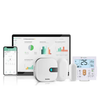
Most of that work becomes automatic once it runs from a single system. Sensibo Airbend for Schools puts every classroom air conditioner on one dashboard, sets schedules around the academic calendar, and reports the energy and air quality figures that district targets and certification bodies ask for. A district can measure its first savings within a term and turn that record into the baseline for the work that follows.
FAQ
Does smart HVAC control require replacing a school's air conditioners?
No. Retrofit controllers attach to the air conditioners and heat pumps a school already runs, as long as those units use an infrared remote.
Is benchmarking or a solar install the cheaper way to start?
Benchmarking through ENERGY STAR Portfolio Manager is free and sets the baseline every later project depends on. A solar install carries a large upfront cost and a payback measured in years.
Can HVAC controls alone earn a school its certification?
They contribute strong points toward energy and air quality credits, but no single system certifies a building on its own. Certification combines several categories that controls support rather than complete.
Do smart controls work in schools without a building automation system?
Yes. Retrofit controllers reach standalone, mini-split, and window units that a central building automation system cannot control.
How soon do energy savings appear after installation?
Savings usually show within the first billing cycles, once schedules match real occupancy and empty buildings stop running conditioning.
Who manages classroom temperature once control is centralized?
Facilities staff set schedules and policies for the whole district from one dashboard, and individual rooms can keep limited local adjustments if the district allows it.