






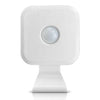


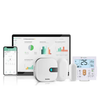

























A hygrometer is an instrument that measures humidity in the air. Most consumer models display relative humidity (RH) as a percentage, representing how much water vapor the air currently holds compared to the maximum it could hold at that temperature. A reading of 50% RH means the air is carrying half its capacity. The EPA recommends 30-50% indoors year-round, though the best humidity level for a home in summer depends on cooling behavior and climate zone.
A hygrometer only reads and displays. It does not control any connected equipment. A device that both measures humidity and switches a humidifier or dehumidifier on and off is a humidistat.
Hygrometer vs. Moisture Meter
The two get confused regularly. A hygrometer measures water vapor in the air. A moisture meter measures water content trapped inside solid materials like drywall, wood, or concrete. After a pipe burst or flood, a moisture meter tells you if the walls are wet. A hygrometer tells you if the room's air is still holding excess moisture. Different tools, different targets.
How Far Off Each Sensor Type Can Be
Type |
How It Works |
Typical Accuracy |
Capacitive (digital) |
Thin polymer film changes electrical capacitance as it absorbs moisture |
±2-3% RH |
Resistive (digital) |
Ceramic substrate changes electrical resistance with humidity |
±3-5% RH |
Mechanical (analog dial) |
Hair, nylon, or paper strip expands/contracts with moisture |
±5-10% RH |
Psychrometer (wet/dry bulb) |
Compares evaporation cooling between a wet-wick thermometer and a dry one |
±1-2% RH when properly operated |
Digital capacitive sensors dominate the consumer and HVAC market. Psychrometers remain the field reference tool for HVAC technicians verifying refrigerant charge and airflow, though handheld digital units are replacing them in most service calls.
How to Calibrate With the Salt Test
Consumer hygrometers drift. The simplest check uses table salt and a sealed container. Fill a bottle cap with salt, add enough water to make a wet paste (not dissolved), place it inside a sealed zip-lock bag alongside the hygrometer, and wait 8-12 hours. A saturated salt solution produces exactly 75% RH at room temperature. If the hygrometer reads something other than 75%, the difference is its current error. Some digital units have a calibration button; for those that don't, note the offset and adjust mentally when reading. Once you trust the number, the next step is calculating and reducing your home's humidity level based on what the corrected reading shows.
What a Hygrometer Cannot Tell You
A standard consumer hygrometer reads relative humidity at the sensor's location. It does not detect mold, identify allergens, or measure air quality. It will not reveal localized moisture problems behind walls or under floors. And because RH is temperature-dependent, a hygrometer reading in a cold basement and a warm living room can show different percentages even when the actual moisture content of the air is identical.