






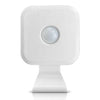



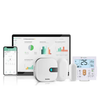

























An occupancy sensor is a device that detects the presence or absence of people in a room and sends that signal to a connected system, typically lighting, HVAC, or both. When the room is empty, the system can turn off lights or setback the temperature. When someone enters, it restores full operation. The goal is to stop conditioning and illuminating rooms that nobody is using, which in commercial buildings can represent a large share of operating hours.
Sensor Technologies
Type |
Detection Method |
Strengths |
Weaknesses |
PIR (Passive Infrared) |
Detects body heat movement across zones in the sensor's field of view |
Low cost, low power, no false triggers from airflow |
Requires motion; a person sitting still for an extended period may be marked absent |
Ultrasonic |
Emits high-frequency sound waves and measures reflection changes |
Detects subtle movement (typing, breathing); works around obstacles |
More expensive; can false-trigger from airflow near HVAC diffusers |
Dual-technology (PIR + ultrasonic) |
Requires both sensors to agree before switching state |
Lowest false-positive and false-negative rates |
Higher cost; more complex wiring or setup |
mmWave / radar |
Emits millimeter-wave signals that detect micro-movements like breathing |
Detects stationary occupants reliably; works through some materials |
Newest and most expensive; limited product availability |
PIR sensors dominate residential and light commercial installations because they are cheap and reliable enough for most applications. The main failure mode is a timeout that marks a still-occupied room as vacant, which is an annoyance with lighting but a comfort problem with HVAC if the system enters deep setback while someone is sitting quietly at a desk.
Occupancy Sensing in HVAC
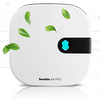
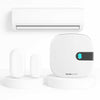
In ducted commercial systems, occupancy data feeds into the BMS or VAV controller, which closes dampers or raises the cooling setpoint in unoccupied zones. In ductless residential and light commercial setups, occupancy sensing can be built into the smart controller or added as a wireless accessory. The controller turns the AC off or to an economy mode when the room empties and restores the previous setting when someone returns, removing the need for anyone to remember to adjust the thermostat on the way out.
The energy savings depend on how many hours per day rooms sit empty with the HVAC running at full comfort. A home office used eight hours a day wastes less than a hotel room vacant 14 hours a day. In hospitality and multi-unit properties, occupancy-based control is one of the highest-return HVAC interventions available.